 Loading...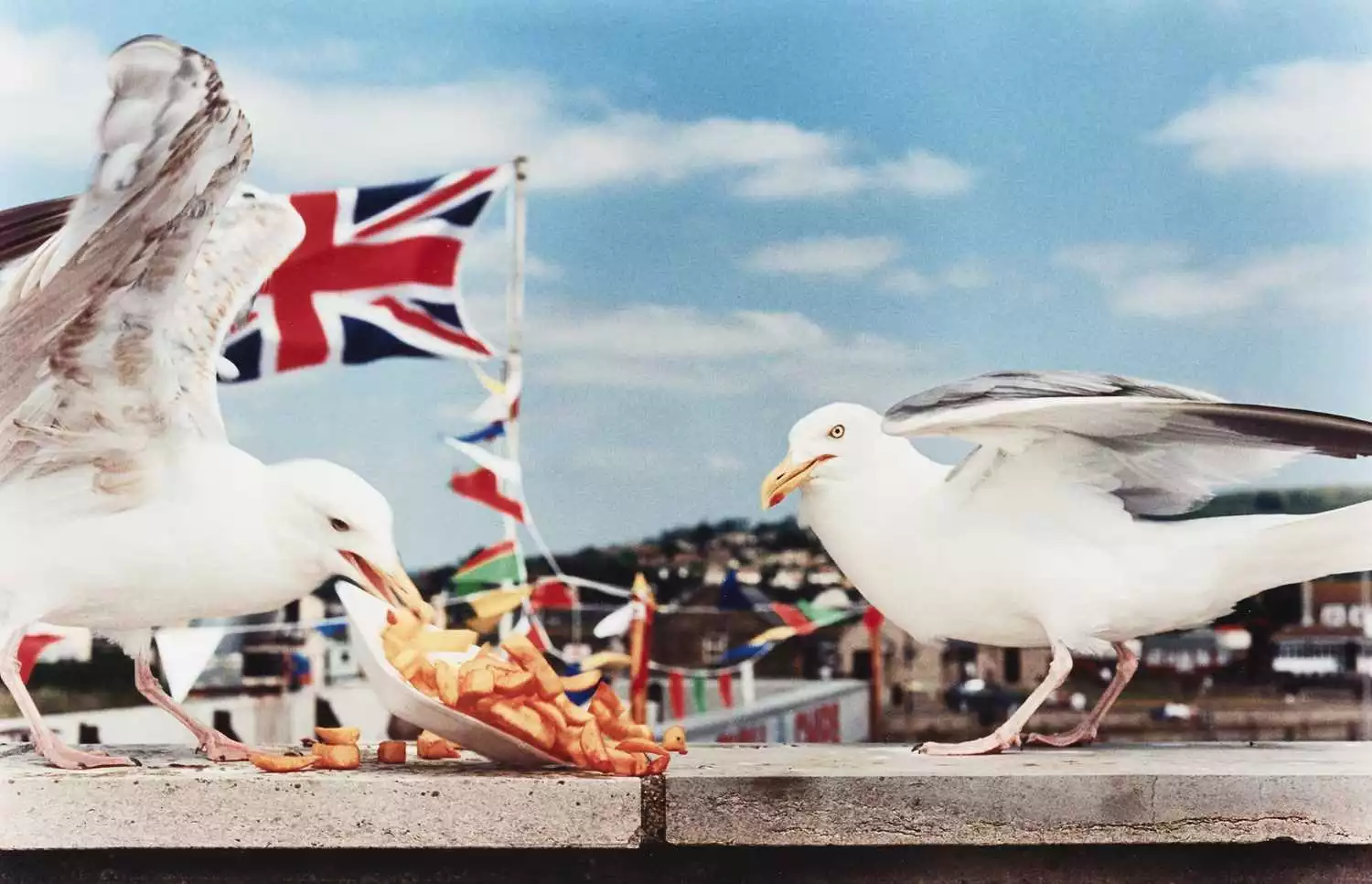
A
Andrew
As of 2025, he is not a prince, but simply Andrew Mountbatten-Windsor, a private citizen. The King stripped him of all titles, royal residence and other privileges for his erotic escapades during his years of friendship with scandalous pimp and sex offender Jeffrey Epstein.
Other prominent Britons have also been burned for their association with Epstein this year. For example, political heavyweight Peter Mandelson was fired from his post as British ambassador to the United States. And back in 2025, evidence of Epstein’s ties to Richard Branson, Bill Clinton, Donald Trump, and Ilon Musk began to surface. The spirit of pedophile Epstein, who committed suicide in prison back in 2019, even years later continues to retroactively poison the lives of many powerful people. We are likely to hear his name more than once next year in connection with new sensational scandals, revelations and resignations.
Asylum seekers
Asylum seekers in 2025 remained one of the most discussed and controversial topics in society.
According to government figures, 111,084 asylum claims were made in the UK between June 2024 and June 2025, up 14% from a year earlier. Around half of these applicants arrived via illegal routes, including crossing the Channel by boat. The Labor government announced sweeping reforms to the asylum system in 2025, including a shift from permanent to temporary refugee status – asylum will no longer be granted permanently, but only for as long as it is dangerous to return to the country from which the refugee came. It will become much more difficult to obtain a permanent residence permit – instead of 5 years in the country it will be necessary to live for 20 years. However, the latter measure will apply to everyone, not just asylum seekers.
Adolescence
Emmy Award-winning Best British TV series of 2025. This is Stephen Graham’s dark drama about family relationships and teenage cruelty, which made the whole of Britain think about why children resort to violence and adults can do nothing about it.
B
Birmingham bin strike
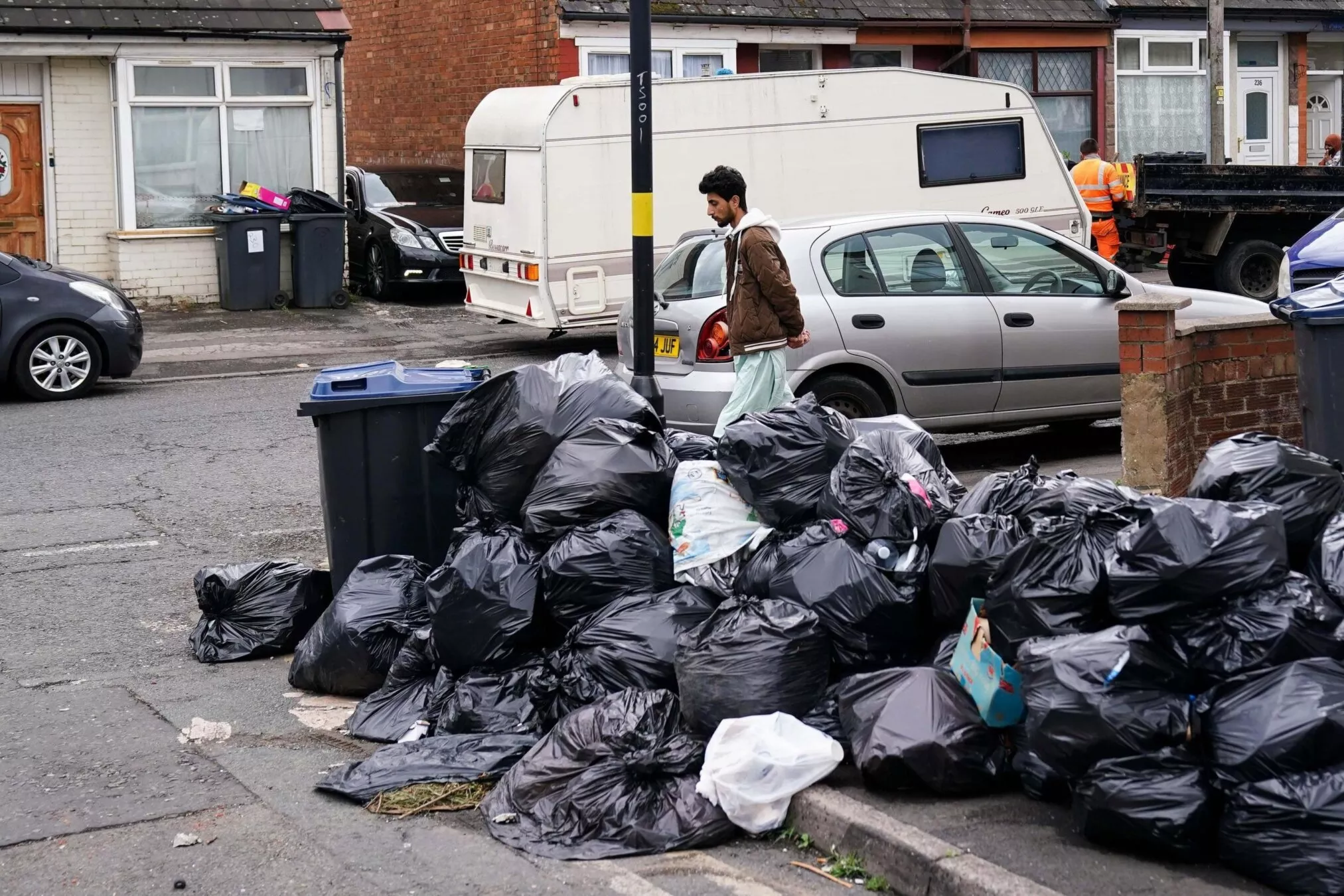
For the letter B, the main event of the year is the garbage strike in Birmingham. It started in March 2025 and has turned from a local labor conflict into a symbol of a systemic crisis of city management. Birmingham City Council binmen protesting against their employer’s decision to change staffing levels, which they expect will lead to a reduction in their salaries. According to the workers, this means a loss of up to £8,000 a year (for some of them). City officials insist that the scale of the problem is exaggerated and that the workers have been offered alternatives, but no compromise has been reached. Meanwhile, the effects of the strike have become tangible: the streets have been littered with waste for months, authorities have declared an emergency, and residents have complained of rats and unsanitary conditions. The strike will continue into 2026.
Bulgarian spies
Six Bulgarian citizens living in Britain have been convicted this year of spying for Russia for terms ranging from 5 to 10 years. The media reported that they had collected information on journalists and political figures for the Russian intelligence services.
C
Chagos
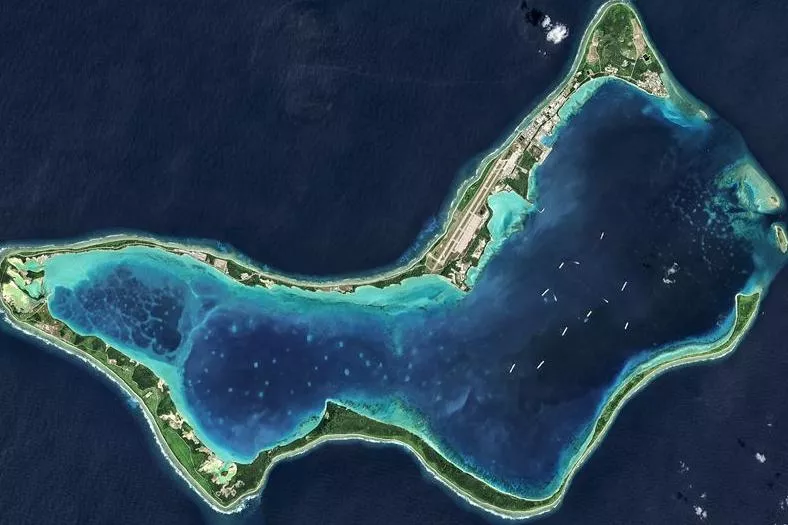
An archipelago in the Indian Ocean, which the UK did hand over to Mauritius this year. Now it will pay this state about 100 million pounds a year to rent its own military base located on these islands.
The transfer of Chagos is sometimes called the final nail in the coffin of the British Empire, which once owned a quarter of the globe. But this is an exaggeration: Britain still has other overseas territories: the Falklands, Gibraltar and a handful of islands in the Caribbean.
Cyber attacks
In terms of cyberattacks, 2025 was a particularly bad year for retailers. Several major UK companies were hit, disrupting in-store and online services. Marks & Spencer and Co-operative Group were hit hardest – the latter even temporarily shut down some of its IT infrastructure to contain the attack. Harrods department store, LNER and many other companies were also hit. The attacks were accompanied by service disruptions and, according to experts, caused significant financial and reputational damage, as well as the theft of customers’ personal data.
Ethel Caterham
A British woman from Sarrey County named Ethel Keterem became the world’s longest-living person in 2025, surpassing the previous record holder, Brazilian Inah Canabarro Lucas. On August 21, Mrs. Ketheram turned 116 years old.
D
Digital ID
In 2025, the British government under the leadership of Keir Starmer has proposed the introduction of digital identity cards (Digital ID). The aim is to enable British residents to quickly confirm their right to work and access public services, and for the authorities to more effectively combat illegal migration and other violations of the law. Everyone was told from the start that participation in the scheme would be purely voluntary, but that didn’t stop critics from calling it a “digital leash.” Many people opposed the innovation – by the end of December, a petition against the introduction of digital IDs posted on the gov.uk website had gained almost 3 million signatures.
Tim Davie
Also on D this year is Tim Davie, who voluntarily stepped down as Director General of the BBC after the facts of the unfair work of the authors of the program Panorama came to light. The case concerned an issue about Donald Trump, whose recordings of his speeches were edited in such a way that the public got the impression that he was calling on Americans to storm the White House in 2021, when in fact he had not.
Along with Davy, Deborah Turness, head of news services, resigned. And Trump sued the BBC, claiming $5 billion (more than half the annual budget of the entire British Broadcasting Corporation). We will find out how this story ends next year.
E
Erasmus
In December 2025, the UK and the European Union agreed to return the country to the Erasmus student exchange program. UK participation will resume from the 2027-2028 academic year, allowing UK students, interns and teachers to study, intern and work in EU countries again. The UK withdrew from the program in 2020. Universities and student associations have generally welcomed the return of Erasmus. Critics, however, are concerned about whether the national Turing program, which funded overseas travel for British students after Brexit, will suffer because of this return.
End of Life Bill
This bill proposes to allow assisted dying for terminally ill adults with a life expectancy of up to six months. The House of Commons approved it in 2025 and sent it to the House of Lords, where it is now undergoing clause-by-clause consideration. The Lords, for their part, are dragging their feet on passing it – they’ve tabled over a thousand amendments to it. The problem is that if it is not approved by the spring, then the consideration will have to start all over again – from the House of Commons.
Elections Bill
The main goal of this bill, which the parliament has been working on for the past year, is to lower the age threshold for participation in elections from 18 to 16. Labor believes it is necessary to involve young people in politics from an earlier age.
A similar practice is already in place in Scotland and Wales, where 16- and 17-year-olds can vote in local and regional elections. The government considers this experience a success and wants to extend it to the whole country and to parliamentary elections.
The supposed innovation is controversial. Supporters talk about expanding democracy and that teenagers should develop the habit of going to the polls. Critics question the political maturity of teenagers and fear their choices will be too easily influenced. The House of Commons has yet to approve the bill.
F

Tuition Fees
In the past year, Britain raised the maximum tuition fee for higher education for the first time in eight years. For British students it rose from £9,250 to £9,535 a year. But that’s not all: in the future, the authorities plan to annually index the ceiling of tuition fees in line with inflation. However, only for those universities that meet the new requirements for the quality of education and student success.
Soldier F
This is the assumed name of a British serviceman, his real name has not been released. He took part in the events of Bloody Sunday in Northern Ireland on January 30, 1972, and was accused of shooting unarmed people.
On that day, soldiers opened fire on peaceful marchers against internment without trial, killing 13 unarmed civilians. Soldier F tried to be charged with the murders of James Ray and William McKinney, as well as the attempted murder of several others. The soldier himself claimed that he had only fired at armed men, but this was rejected by the inquiry report.
An initial investigation back in the 1970s exonerated the Army, but the families of the victims later succeeded in getting the Army to admit that the soldiers had fired first and for no good reason. In 2025 – more than 50 years after the tragic events of January 1972 – the criminal case against Soldier F went to trial. But it turned out that the evidence of the soldier’s guilt was insufficient for a conviction, and the judge acquitted Soldier F.
G
Grooming gangs inquiry
In 2025, the UK took an important step towards a national inquiry into so-called grooming gangs – organized groups that sexually exploited children across the country. After years of pressure from victims and human rights activists, the government accepted the findings of an independent audit that revealed serious failings in police, local authorities and social services.
By the end of the year, authorities officially launched an independent investigation – with the power to demand documents and call witnesses. It will not only investigate the crimes of the groups, but will also analyze the systemic errors that allowed the violence to last for years. Among other things, it is likely to answer the question of how much the authorities’ work was hampered by “inconvenient” ethnic and cultural issues (some of the groups involved in the crimes were predominantly Pakistani, and many believe law enforcement may have failed to act for fear of being accused of racism).
H
Homebase
The last Homebase DIY stores, once founded by Sainsbury’s, closed in March 2025. Its competitors Wickes and B&Q have opened in hangars owned by the chain.
I
India free trade deal
In 2025, the UK and India entered into the Free Trade Agreement (FTA), one of the UK’s most significant post-Brexit trade agreements, which is expected to help boost the country’s GDP by billions of pounds in the coming years.
The agreement includes substantial tariff reductions and increased market access. India has agreed to phase out duties on key British goods – such as whisky, automobiles and a range of industrial and food products – while the UK has pledged to eliminate tariffs on the vast majority of Indian goods, particularly benefiting the textile, pharmaceutical and engineering sectors. In addition to trade in goods, the agreement also facilitates trade in services (including professional and financial services). Certain categories of highly skilled professionals will find it easier to come to work in the UK.
Interest rates
In the past year, the Bank of England’s key interest rate has been reduced several times, and a lot of things depend on it: mortgage payments, credit availability, return on contributions (and indirectly it affects the prices of all goods and services in the country). It was 4.75% in December 2024 and has been gradually falling throughout 2025 and is currently at 3.75%. This has made life much easier for people paying floating rate mortgages and stimulated economic activity in the country.
ILR
It is possible that migrants in Britain will have to wait as long as twenty years to obtain ILR (Indefinite Leave to Remain). Home Secretary Shabana Mahmood announced the government’s plans to increase the period during which migrants who arrived in the UK legally must wait for permanent residence documents in 2025. This has frightened many residents of the country, especially recent arrivals. The new rules, if passed, would affect 2.6 million people.
J
JPMorgan
Financial giant JPMorgan has announced it will build a new skyscraper in Canary Wharf in 2025 – on the west side of Isle of Dogs, right on the banks of the Thames, near Westferry Circus. It will be one of the largest office buildings not only in London, but in the whole of Europe, and in terms of height the new tower will be the second in the area after One Canada Square.
K
Hadush Kebatu
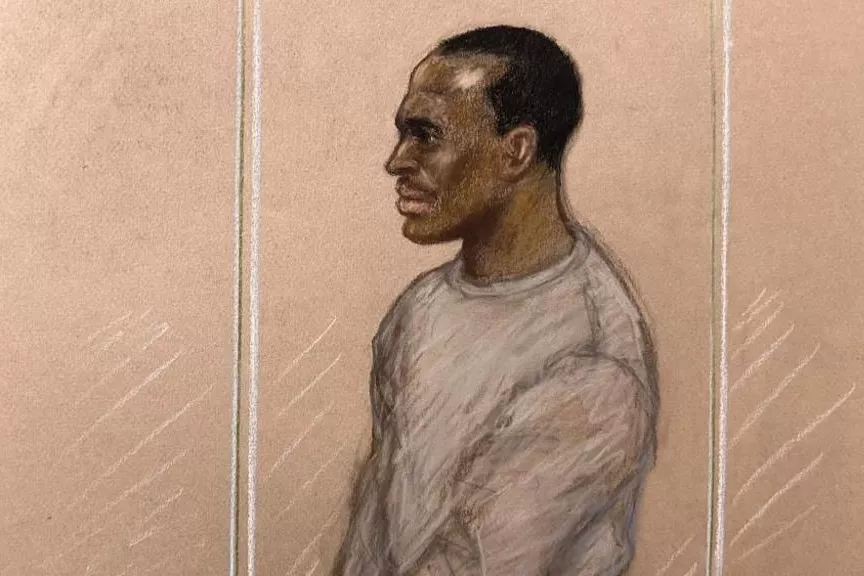
In a high-profile scandal at HMP Chelmsford prison in Essex, an Ethiopian national named Hadouche Kebatu was wrongly released after being convicted of sexual assault on a minor and given a 12-month prison sentence. In October 2025, Kebatu was due to be transferred from HMP Chelmsford prison to an immigration detention facility for deportation, but due to slackness on the part of prison staff, he was simply released and left by train for London and stayed there for about two days before police apprehended him.
The whole of Britain laughed at the story, but the truth is that this is not an isolated case. It turned out that the mistaken release of prisoners is a systemic problem in the whole correctional system: in the same year 2025, for example, four prisoners were mistakenly released from HMP Wandsworth in London.
L
Lucy Letby
In early 2025, there was an apparent change of tone in media coverage of the case of nurse Lucy Letby, sentenced in 2023 to life imprisonment for killing babies at the hospital where she worked.
An international commission consisting of experienced doctors studied the case materials and concluded that there was no indisputable evidence of her guilt in the medical documents. According to their version, the deaths of the seven infants could be attributed to natural causes and poor organization of care in the ward. These findings were the basis for an appeal to the Criminal Cases Review Commission (CCRC). This was the first time that doubts were raised at a serious level: what if the verdict was wrong?
Marina Lewycka
This November, Marina Levitskaya, a British writer with Ukrainian roots who in 2005 wrote the famous humorous book A Brief History of Tractors in Ukrainian, passed away. In it, an elderly British man falls in love with a young migrant woman from Ukraine, whom Levitskaya portrayed as a womanizer and an unscrupulous and promiscuous golddigger. The book damaged the reputation of Eastern European women but won various literary prizes and became a bestseller in Britain and elsewhere in Europe.
M

Manchester synagogue attack
On October 2, there was an attack on a synagogue in Manchester that left two people dead, three others injured, and a suspect shot dead by police. Prime Minister Keir Starmer condemned the Yom Kippur attack and cut short an early trip to Denmark to chair a COBRA committee meeting in London.
The attack on a synagogue in Manchester in 2025 was carried out by Jihad al-Shamie, a 35-year-old British man of Syrian descent. He drove a car into people near Heaton Park Hebrew Congregation and then attacked them with a knife; the attack took place on October 2, 2025 on Yom Kippur, a major Jewish holiday. The police treated the incident as a terrorist attack and the attacker was shot dead on the spot.
Monzo Bank
A major financial scandal of the past year: Monzo Bank was fined £21 million by the UK’s Financial Conduct Authority after it was discovered that it allowed its customers to register fictitious addresses, such as 10 Downing Street and Buckingham Palace. It turned out that the popular bank had not checked its customers’ addresses at all.
Blaise Metreweli
Blaise Metreveli, a British woman with Russian and Georgian roots, became the 18th head of MI6 in 2025, succeeding Sir Richard Moore. She is the first woman to lead the service in its 116-year history.
N
Net migration
The Office for National Statistics calculated that net migration in the 12 months from June 2024 to June 2025 fell by two-thirds compared to the same period 2023-2024. The figure was 204,000 compared to 649,000 a year earlier, with the decline mainly due to fewer people coming to study or work. Only the number of refugees continued to grow. Who would have thought even ten years ago that Britain would one day cease to be a country attractive to students and migrant workers?
NICs
National Insurance contributions (NICs) have increased in the UK since April 6. Whereas previous cabinets reduced the rate for employees, the current government had to do the opposite, but only for employers – from 13.8% to 15%. The tax-free threshold has also been lowered, from £9,100 to £5,000 a year.
This was done to compensate for falling budget revenues and stabilize public finances. The result was that it became more expensive for companies to hire staff, but the net income of employees did not decrease.
Authorities have attributed the increase to the need to fund the NHS, social spending and pensions, emphasizing that the burden is deliberately being shifted from individuals to businesses. Critics pointed out that the increase in NICs for employers could stifle wage growth and recruitment of new employees, especially in small businesses.
New Trafford
Manchester United Football Club has announced plans to build the UK’s largest soccer stadium – on the site of the current Old Trafford stadium. The cost of the project will be £2 billion, and the capacity of the new stadium will be 100,000 spectators.
O
Ozzy Osbourne
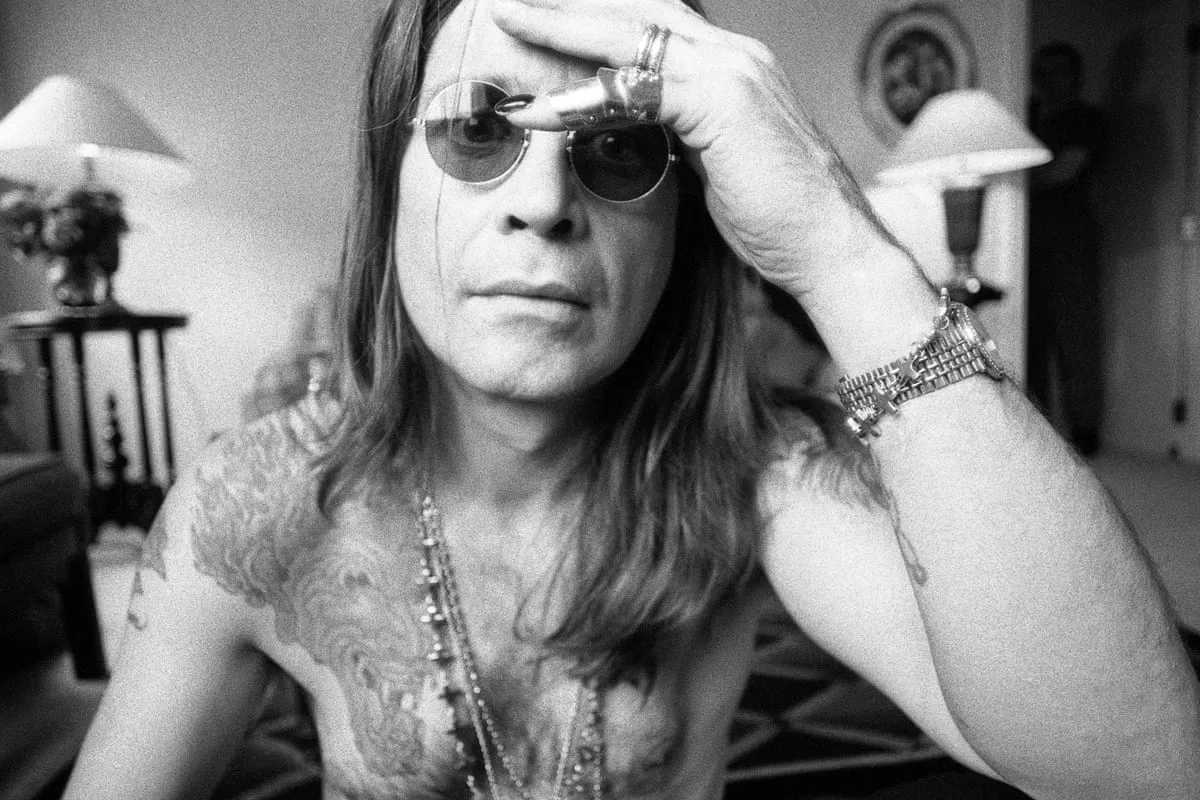
On July 22, Ozzy Osbourne, frontman of Black Sabbath and one of the most important figures of world rock music, died at the age of 76. His death came as a shock to fans around the world: Osbourne was not just a musician, but a symbol of an entire era. Even in his final years, despite severe health problems, he continued to perform – his last concert took place only 17 days before his death.
Oasis
The band Oasis began their five-month world tour in Cardiff in July 2025 and finished in Brazil’s Sao Paulo in November. These were the band’s first live concerts in 16 years.
The intrigue of the Oasis reunion tour was that almost no one believed until the end that it would take place at all. The band has a reputation for constantly breaking up due to internal conflicts, and the relationship between the Gallagher brothers has been so strained for years that fans and journalists seriously expected the tour to be canceled at any moment.
Online Safety Act
In the UK, the Online Safety Act came into force this year, requiring online platforms, social networks and search services to more actively protect users from illegal and harmful content, including extremist messages and child sexual abuse. They are also required to better protect users from fraud and harassment. Companies now bear direct legal responsibility for how their algorithms work and how quickly they react to dangerous content, and violations are subject to large fines of up to 10% of global turnover.
The law is overseen by Ofcom, which will now be able to inspect companies and block services. The authorities claim that the aim of the law is to make the Internet “safe by default”, especially for children and teenagers. Critics, however, fear that the Online Safety Act could lead to excessive censorship, pressure on free speech and increased control over digital platforms, making Britain one of the most regulated online markets in the world.
Fun fact: after the law came into force, popular porn sites were forced to introduce real age verification for their users (instead of checking the “I am 18 years old” box) – and immediately lost a huge share of traffic. Thus, Pornhub reported a 77% drop in the number of users. By contrast, VPN apps that allow you to bypass the rules became the most downloaded apps in Britain.
P
PIP (Personal Independence Payment)
A strange story has been happening in Britain for a few years with mental illness: the number of people with mental illness has risen. And at the same time the number of people receiving PIP (Personal Independence Payment), which is often prescribed for people suffering from a mental disorder, has also increased significantly. Young Britons aged 16 to 34 were particularly active in applying for it.
In 2025, the media and analysts started talking about it. However, no one can really explain what is going on. Either people have figured out how to “hack” the system and get a few hundred pounds a month in addition to benefits or salary by lying to the local doctor about depression. Or whether life in Britain has really become too hard, especially for young people. There are arguments in favor of both versions.
The piquancy of the situation is that this phenomenon is not observed in other countries, and it is rather difficult to explain this phenomenon by the consequences of covid, war or any other world cataclysms.
And another interesting context: the Office for National Statistics in the outgoing year calculated that by 2025, Britain will see a record increase in the number of Britons aged 16 to 24 who are neither working nor studying anywhere.
Palestine Action
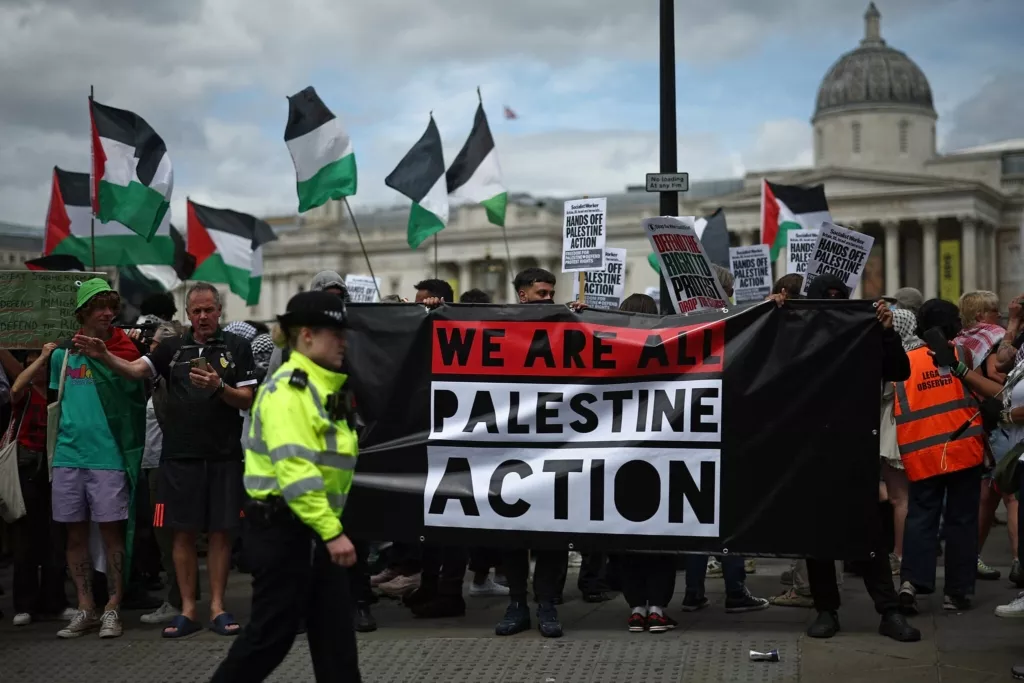
This is the name given to a British protest group that draws public attention to the war in Gaza and opposes British cooperation with the Israeli defense industry. The activists have become famous for their radical but mostly non-violent actions: infiltrating defense company factories, blocking facilities and damaging property. In 2025, the group’s activities became one of the most visible forms of pro-Palestinian protest in the country.
This summer, the government of Keir Starmer officially included the group in the list of banned organizations – on the anti-terrorist “line”, explaining the ban by the fact that the actions of activists allegedly threatened national security and critical infrastructure. Critics called the move unprecedented: previously, Britain had not equated protest movements with terrorist organizations.
The ban sparked a wave of protests across the country. Demonstrations in support of Palestine Action took place in London and other cities, where participants claimed that the state was using anti-terrorism laws to suppress political dissent and solidarity with Palestine.
These protests were the subject of one of Banksy’s 2025 works, which depicted a judge in a wig hitting an anti-war rally participant with a baton.
Martin Parr
Martin Parr, the legendary British documentary photographer and one of the most recognizable authors of the late 20th and early 21st centuries, passed away this year. He became famous for his vivid, deliberately “screaming” color photographs of everyday life: recreation at British resorts, consumption, mass tourism, food, fashion and everyday rituals of the middle class. His style is often described as ironic, satirical and even ruthless – Parr was able to find the absurd and grotesque in the most mundane scenes.
Q
Quishing
Quishing is not a new, but in 2025 it has become a popular method of fraud: stickers with incorrect QR codes on parking and other payment machines. A person wants to pay for parking, sees a QR code, scans it, opens a website that looks like a real one and pays 4 pounds – but not to the municipality, but to fraudsters. And he also reveals his card details to them.
R
Reform UK
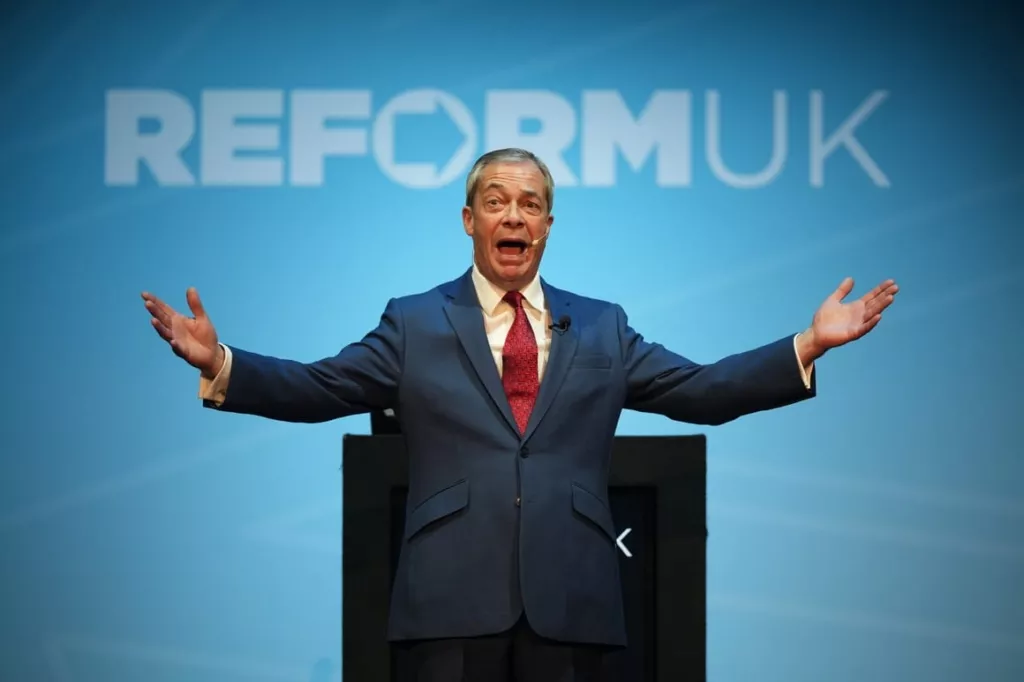
Nigel Farage’s party in 2025 announced that it had overtaken Labor to become the largest party in the country. It also performed well in the municipal elections this year, winning 10 constituencies and significantly consolidating its position at the local level. Against the backdrop of Johnson, Sunak and Truss-era Conservatives who have lost credibility and Sturmer’s indecisive and untalented Labor, Farage does look like a good option for many voters, especially when you consider that the world as a whole is going through a phase of fatigue with liberal values and is ready to vote for the devil if he adopts anti-immigrant rhetoric.
Angela Rayner
In August 2025, a political scandal erupted – after it emerged that Deputy Prime Minister Angela Rayner had underpaid £40,000 of stamp duty when buying an £800,000 apartment in Hove in May that year. It involved complex property schemes and contradictory statements about Rayner’s main residence submitted to different public bodies.
Under media pressure, Rayner admitted the mistake, and went to the Prime Minister’s independent adviser on ministerial standards herself. After the ethics adviser concluded that she had not met the “highest standards of appropriate behavior,” Rayner resigned from all her posts in September.
S
Scunthorpe Steelworks
UK authorities saved a critical industry this year by preventing the shutdown of British Steel’s Scunthorpe steelworks. Parliament specifically met to pass the British Steel Act, an emergency powers bill that allows the government to directly protect production, jobs and strategically important supply chains. This comes after the owners of the plant, China’s Jingye Group, announced their intention to immediately shut down the plant’s blast furnaces.
The new measures give the authorities the right to manage key company decisions, ensure salaries are paid and raw materials are supplied to keep domestic steel production essential for national security, infrastructure and housing.
Tom Stoppard
Tom Stoppard, one of the most famous British playwrights of the second half of the 20th and early 21st century, famous for his intellectual, witty and philosophically rich plays, died in 2025. He is widely known for his play “Rosencrantz and Guildenstern Are Dead” (1966), in which he reinterpreted Shakespeare’s “Hamlet” from the point of view of minor characters, combining absurdity, existential philosophy and virtuoso play with words.
Stoppard was known not only as a playwright but also as a screenwriter: he wrote screenplays for films, including Shakespeare in Love (for which he won an Oscar), was active in political and human rights debates (including supporting the Belarusian Free Theater), and addressed themes of history, freedom, and personal responsibility.
T
Too little too late
It’s a phrase that’s been walking the newspaper pages this year – as succinct as possible in the second report on the impact of the Covid-19 pandemic in the UK and the actions of the authorities, published in November.
The report showed that the UK authorities reacted too late and too hesitantly to the pandemic. In early 2020, the government and scientists underestimated the danger of the virus, believing that the country could cope on its own and that restrictions could be postponed for the sake of so-called collective immunity. If measures like social distance and self-isolation in case of symptoms had been introduced earlier, a hard lockdown imposed later might not have been necessary. But decisions were delayed, and the lockdown itself was imposed a week later than needed – leading to an estimated 23,000 excess deaths in the first wave.
In the fall of 2020, the mistakes were repeated: the authorities delayed again, the prime minister hesitated to tighten the measures, and the second lockdown was introduced when the situation got out of control. Additional damage was caused by scandals involving politicians themselves breaking the rules, which undermined people’s trust and reduced their willingness to comply with the restrictions. The atmosphere within the government was chaotic and toxic, and there was a lack of coordination between the various government agencies in the country.
At the same time, the report acknowledged that the vaccination was organized very successfully and was a turning point for the country. It also emphasized that the lockdowns made sense and saved lives, although they had consequences: children who did not go to school suffered, treatment for other diseases was delayed, and social inequalities increased. The report concludes that many deaths could have been prevented with stronger and faster leadership and calls for a change in decision-making so that such a tragedy does not happen again.
U

U-Turns
U-turns – this word, meaning “180 degree turn”, was repeatedly heard by politicians and journalists in 2025 in reference to the actions of the Labor government, which on several occasions radically changed its own plans – literally “re-turned in mid-air”. Labor’s key U-turns were as follows:
- Inheritance tax for family farms.
Labor initially planned to reduce tax exemptions for inheritance of agricultural land, arguing that it was fair and necessary to replenish the budget. The decision sparked widespread protests from farmers and strong pressure from rural MPs. In the end, the government backtracked by raising the tax-free threshold, thus significantly mitigating the effects of the reform. - Welfare Reform.
The government promised a “tough but fair” reform: tougher eligibility criteria for benefits, expanded job search obligations, revision of disability status, and notable budget savings. However, in the course of parliamentary debates and under pressure from public organizations and their own MPs, key measures were weakened. The criteria for recognizing the ability to work were relaxed, sanctions for refusing to work were limited, and the reassessment of disability benefits was postponed. As a result, most of the expected plans were never implemented. - Winter heating allowance for pensioners.
The attempt to save budget money by more selectively targeting the Winter Fuel Allowance provoked a sharp negative reaction from the public and the media. Faced with the risk of serious political damage, the government abandoned the original plan and returned the payments to the majority of pensioners, effectively admitting an error in assessing public sentiment.
V
VAT
In 2025, one of the most controversial topics in British politics was the introduction of VAT (VAT) on private school tuition. The Labor government realized its election promise to abolish the VAT exemption for private schools, declaring it an unjustified tax break for wealthy families. Their logic was simple: private education is a paid service and should be taxed in the same way as most other services in the economy. The proceeds were to be used to finance public schools.
The problem was the consequences of this decision. Private schools almost immediately shifted the VAT to parents, causing tuition costs to skyrocket. Critics warned that this would force some families to transfer their children to public schools, increasing the strain on an already overburdened system. In addition, not only elite schools were affected, but also small independent educational institutions, including religious and special schools operating on minimal profit margins.
W
Woman
In 2025, women continued to assert their rights – calmly and persistently, as they should. But it was this year that history took an interesting turn: the struggle for equality suddenly turned into a struggle for its own borders and for the preservation of the very notion of “woman.
Thus, in April this year, the British Supreme Court ruled that only a biological woman can legally be considered a woman, and no men who consider themselves women are legally women. At the same time, the court separately emphasized that transgender people are still protected from discrimination and harassment.
Then the domino effect kicked in. The British Transport Police announced that searches of detainees will be based on biological sex – male offenders will be searched by male police officers. The Football Association has decided that from June 1, women’s soccer will be women’s soccer after all. The Women’s Institute has decided to no longer offer membership to trans women. And even the Labor Party, which is very indecisive, has announced that trans women will not be allowed to participate in its Women’s Conference. And so on. It looks like the tedious Facebook arguments about who can go into women’s toilets and participate in women’s sporting events will stay in the past year. At least in Britain.
X

XMAS
It’s always hard to find the X word of the year – there aren’t that many of them in the English language. But this year we were lucky: Kylie Minogue’s XMAS overtook Last Christmas by Wham! in the UK Christmas chart to become the number one holiday hit. We congratulate Minogue fans (as well as fans of the letter X).
Y
Your Party
In 2025, the Your Party, a new left-wing project created by former Labour MPs led by Jeremy Corbyn and Zara Sultana, made a loud voice in British politics. The party was conceived as a radical alternative to the “moderate” course of Starmer’s Labor government and promised a return to a hardline socialist agenda. Familiar words rang out: nationalization, higher taxes on the wealthy, and an expanded role for the state in all areas. Almost immediately after the launch, however, public attention shifted from programmatic ideas to the organizational chaos within the new movement.
The key scandal revolved around issues of internal management and finances. Conflict erupted between leading figures in the party over control of donations, supporter databases and membership registration procedures. Hundreds of thousands of pounds were leaked to the public, and the leadership of Your Party even threatened legal action against its own co-founders, accusing them of self-dealing. As a result, instead of becoming a model of a democratic movement “from below”, Your Party became mired in behind-the-scenes squabbles and internal struggles for influence.
Z
Zhenhao Zou
In 2025, Zhenhao Zou, a Chinese national and former UCL student whose case became one of the most high-profile criminal trials in modern Britain, was sentenced. The court found him guilty of a number of serious charges relating to the sexual abuse of women and imposed a lengthy prison sentence. The verdict emphasized that Zou’s actions were serial and premeditated.
The investigation found that Zhenhao Zou systematically met women – including at university and on social networks – after which he invited them for a drink, spiked their drinks with drugs and committed violence. Digital evidence played an important role in the case: videos, photos and correspondence found on his devices, as well as testimonies of several victims, some of whom could not reconstruct the events of the incident for a long time. The case caused a wide public outcry and a heated discussion about safety in universities and the responsibility of educational institutions.