 Loading...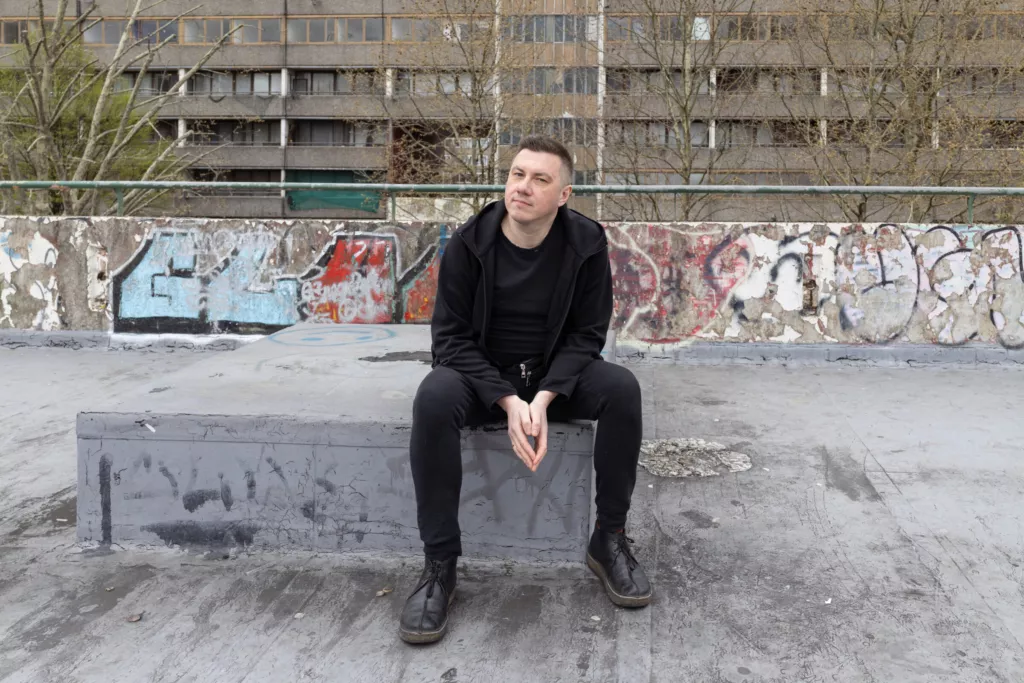
A short train ride from the center of London, an almost mundane route, one of those that imperceptibly changes the city’s rhythm to a more sedate one. It’s not far from the station: over the bridge, then a quiet street with even rows of typical English terraced houses. Pavel Otdelnov and his family live in one of them, and this is also where his studio is located. This explains a lot: the artist has no boundary between life and work. Everything exists side by side.
Pavel Otdelnov is one of the most notable contemporary artists. Born in Dzerzhinsk, he was formed in the Moscow art scene, studied at the Surikov Institute and has exhibited extensively; his work is in international museum collections. He came to London in 2022 to make the exhibition Acting Out at Pushkin House about the Cold War, planned long before the hot war began, and then stayed here on a talent visa.
Pavel’s house looks welcoming: large windows, lots of light, flowers on the windowsill – daffodils, orchids. Vera, the artist’s wife (and also an art historian), treats us to tea. But pretty quickly it becomes clear that the space is more complicated than it seems at first glance. There is a strange sense of recognition inside. The carpet on the wall, the television color grid over the fireplace, the familiar objects of Soviet life are read almost automatically. And yet there is no reproduction of the “native” here, no game of nostalgia. On the contrary, familiar things have a hidden meaning.
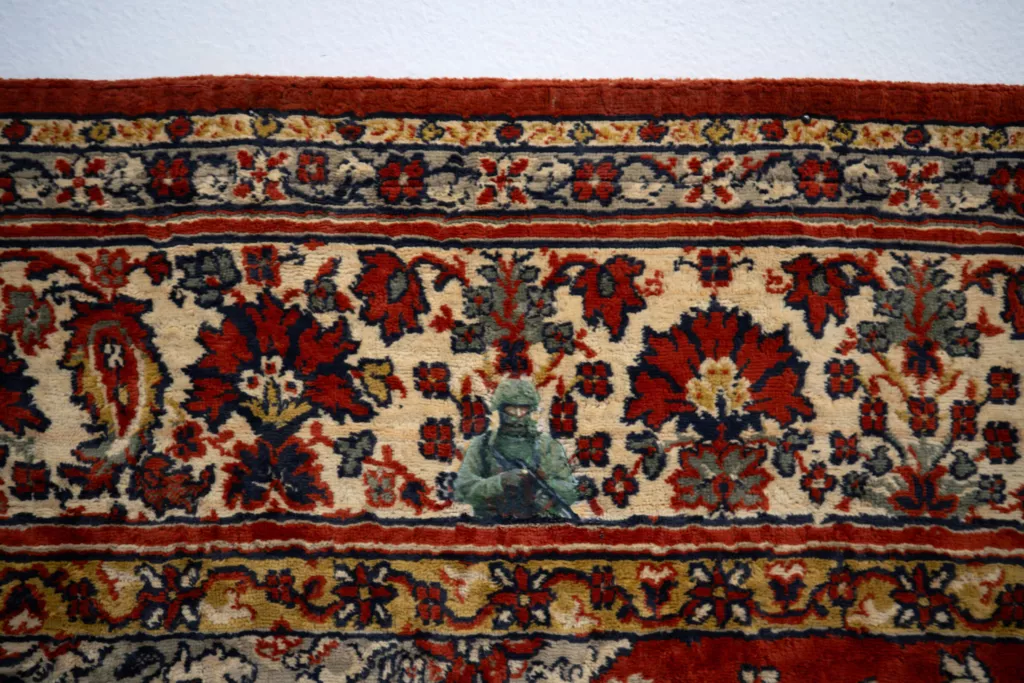
The carpet on the wall, the central object of the living room, is usually perceived as a sign of coziness and does not attract much attention. But if you look closely, the ornamentation begins to reveal military figures, “green men”. Pavel primed several fragments of the carpet and painted over the figures of soldiers. The artist says that this is a version of his earlier work from 2015. After the events of 2014, it seemed to him that it was as if the “little green men” were always already inside the old dusty carpets, as if they had been hiding there since childhood. During the conversation, he refers to the notion of the “uncanny” several times. It is not by chance that he called this work Unheimlich (2024), referring to the Freudian text about the phenomenon of the “uncanny” arising not from the unknown but from the all too familiar.
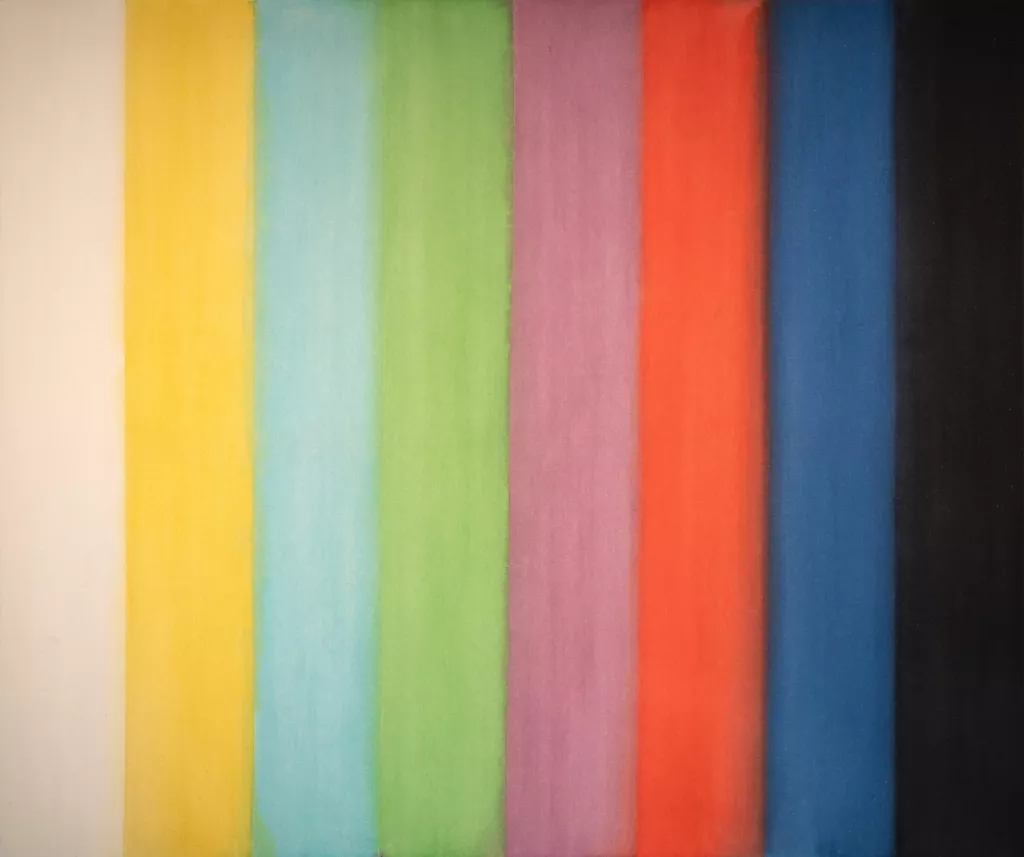
On the mantelpiece is the work No Signal (2023), where in an English home there is usually a television set. But instead of a screen, there are the vertical bands of color of Soviet television that appeared after the broadcast ended. It is, he says, the same “television”, only conveying the absence of a signal. Here, for the first time, he uses a technique new to him: he paints with acrylics on the back of the canvas, allowing the paint to flow, as in watercolor. The image becomes fluid, blurred, existing between recognizable motif and abstraction. The name of the artist Gerhard Richter appears in the conversation, and the comparison is apt: Otdelnov is interested in the space between the subject and its disintegration, between memory and its blurring. Inside the fireplace is a blank for his work Swan Lake (2022) about the failed revolution. Pavel considers this work to be iconic, closely related to today’s time.
His art relies on recognizable images: carpet, television, snow, paneled houses, empty spaces. But they do not become a refuge for nostalgia; the artist defines it as “poisoned”. On the contrary, he shows how nostalgia turns into a trap, and how memory is linked to violence and self-deception. This interior is not a reconstruction of a lost house, but an artistic statement in which the familiar begins to be perceived differently. The carpet, the pseudo-screen, and the street outside the window form a single installation. Pavel laughs as he recalls how passers-by were surprised to see the carpet on the wall through the window in foul Russian. The large windows make the space permeable: the outside and the inside are constantly intersecting.
In general, much of his practice exists “between”: between subject and abstraction, observation and research, home and exhibition, memory and the present. This is also evident in the choice of materials. For some works, construction mesh and concrete are needed to make the painting become almost a fresco. For others, the unprimed side of the canvas so that the image is softer and exists within the fabric. For still others, watercolor, light and fluid. The material here becomes part of the statement.
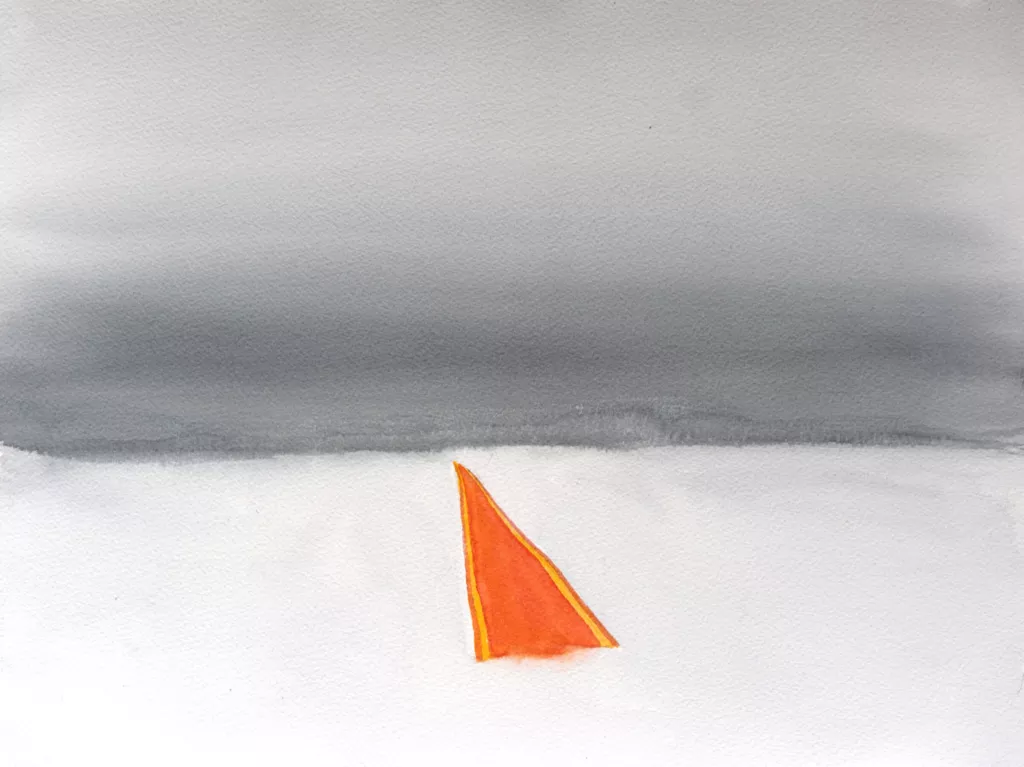
Paul came to London from Sweden, where he had been invited to an exhibition. The war caught their family in Uppsala, in Vera’s words, “lost among the snows”, in a state of uncertainty. There, a cycle of watercolors with a snow field appeared for the exhibition “Russian Field of Experiments.” In this snowy field, objects look especially lonely. The red carpet, the flag, the roadblocks – everything seems concrete and a little detached from reality. The influence of the Russian avant-garde is felt here, but not as a quote, but as a language. The red on white, the geometry, the sign – all this does not lead to the future.
The artist’s London solo exhibitions are organized as a movement of optics: from the historical framework of the Cold War(Acting Out, Nightmare) to Dzerzhinsk(Hometown), then to childhood(A Child in Time) and on to Britain. It is as if he were adjusting the focus: from the general to the particular and outward again.
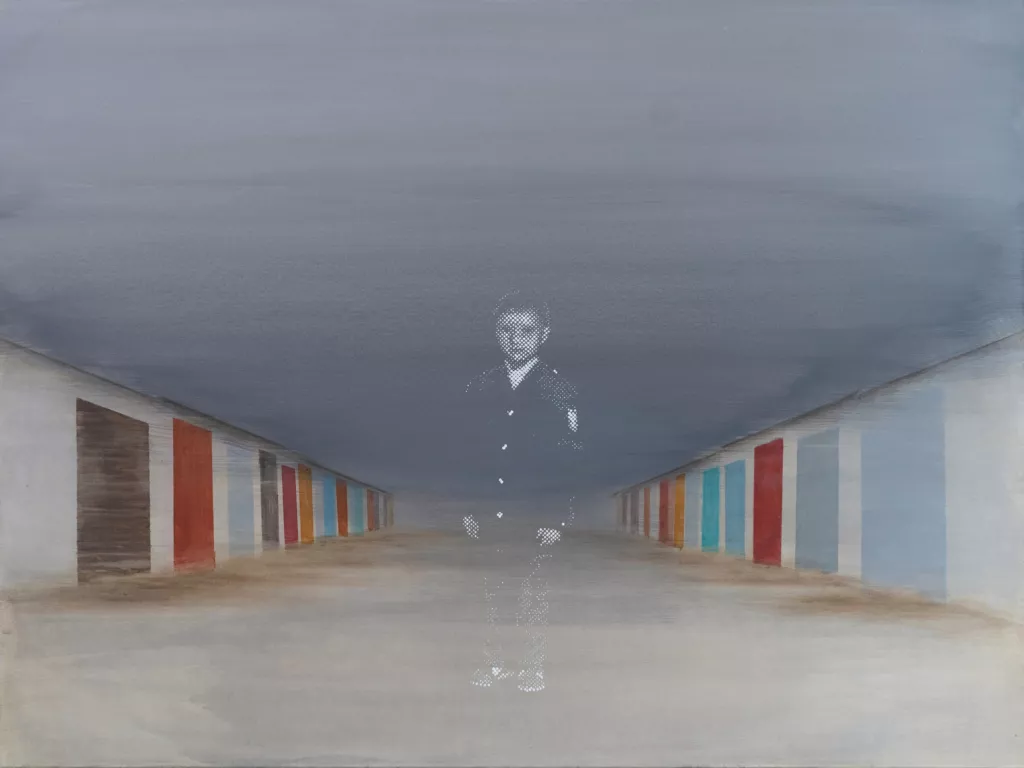
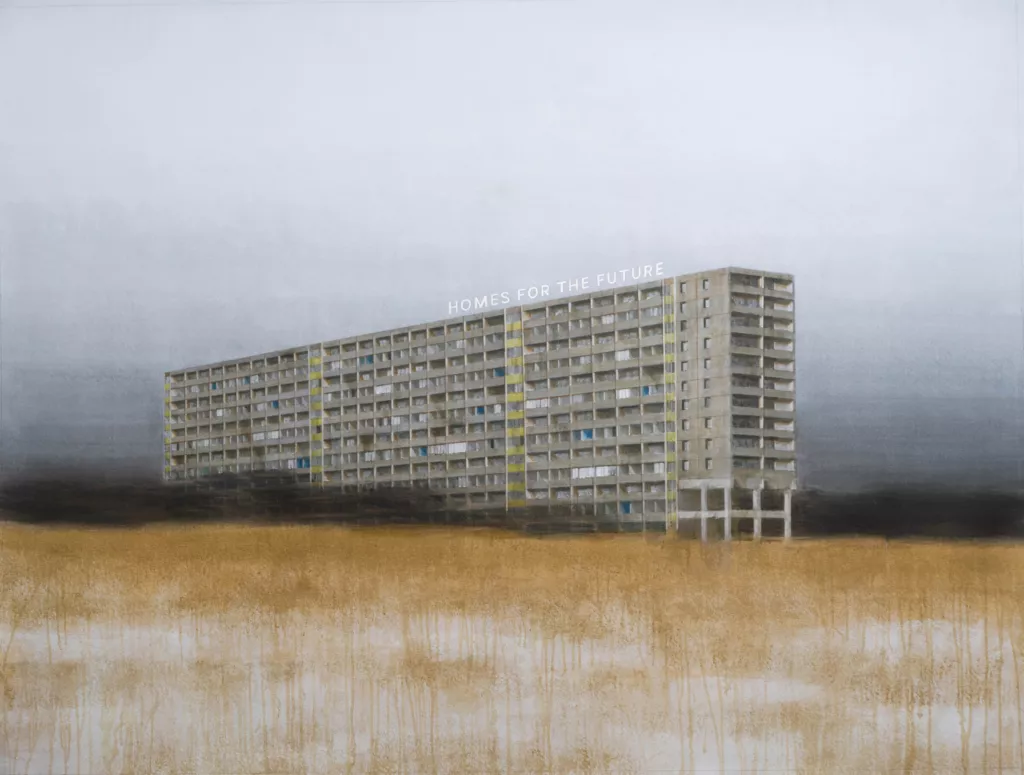
Paul is currently preparing a new exhibition Estates: Fragile Utopia, which opens in April at Lewisham Arthouse. The new series focuses on British social housing, modernist projects that once promised a fairer future. It is not just the buildings that occupy him, but the utopian impulse that shaped them. He speaks of architecture as a “cast of ideas”. This theme continues with his projects about the Russian suburbs and the “Russian nowhere”. The connection between Moscow and London peripheries is read not as a similarity, but as a repetition of a similar logic: the promise of a future that turns out to be alienating and strangely beautiful.
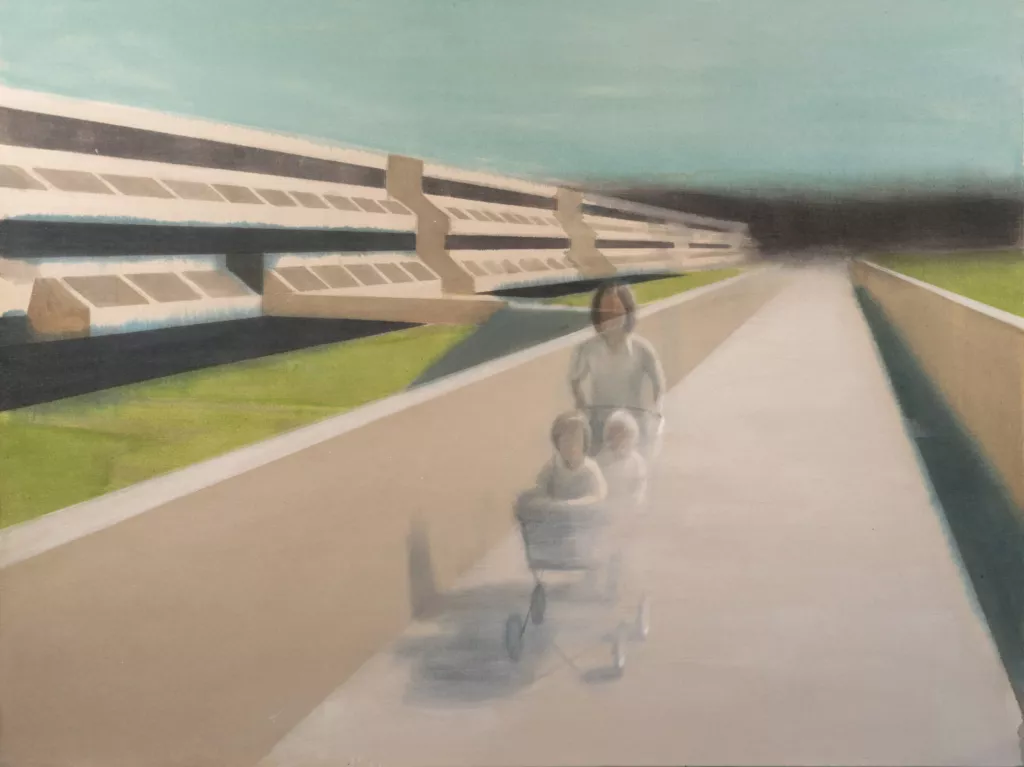
In some new works, a white stripe appears as a reflection on the glass, as if we are looking through the window of a moving bus. When I say that it is perceived as a sign of distance, the artist agrees: “a double bystander for both that reality and this one.” This distance is important to him: it allows him to see more clearly. This does not only apply to the emigrant experience, the distance changes the view on the past and on childhood. Speaking of Russia, he mentions cultural “layers,” small enclaves in which artistic and intellectual life now exists. Distance allows us to see both their fragility and necessity.
The new works continue a conversation, understandable to British viewers as well, about the concrete history of social housing and post-war hopes. But another important thing is that Otdelnov approaches this topic not as an outside observer, but from his own experience of the post-Soviet space, seeing it in a broader context. This is echoed in his project “Russian Nowhere” (2020) – landscapes without an exact address, but with universal recognizability. Then came the work “Zhuten” (2020), a word from network subculture that has become an accurate designation of post-Soviet everyday chthony. He ironically calls London’s social housing “the same”, not literally, but in feeling.
While we are standing in the living room talking about the work, a janitor walks by outside the window, notices Paul and waves to him in a friendly manner. This little episode is memorable. Probably because it immediately brings everything back to the present day, to London life, where the artist is already embedded in his street and his neighborhood.
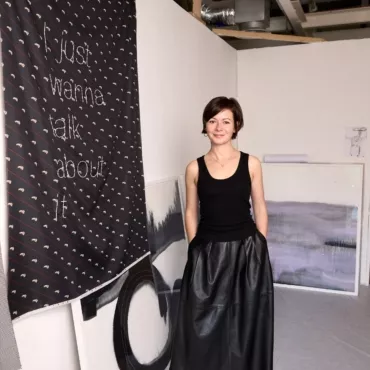
In the studio you can see how the different periods of his work coexist side by side. Large format canvases stand in rolls along the walls. The large-scale paintings do not fit into the room, and there is a logic in this: large themes are inside private life.
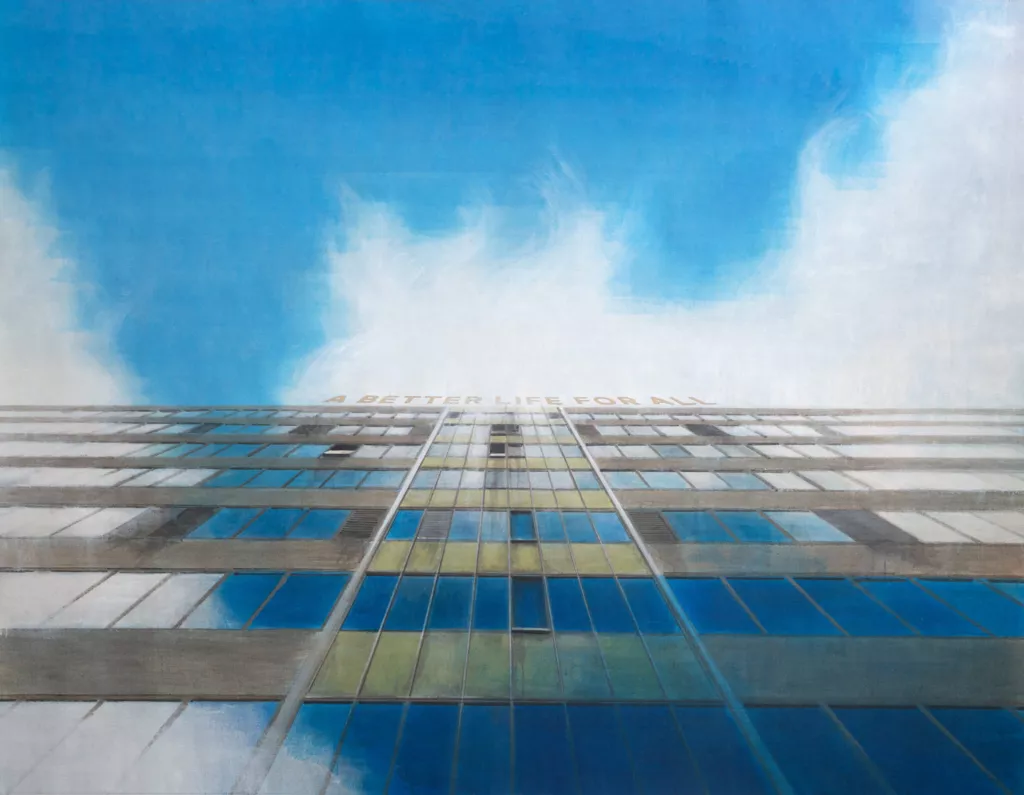
The main impression from this meeting is the feeling of internal coherence in everything that Pavel does. The works vary in technique and material, but are united by the desire to understand how the past continues to live in the present, how memory hides in the everyday and how anxiety arises from the all too familiar. His art does not offer ready-made answers, it forces you to look closer.
An exhibition of works by Pavel Otdelnov Estates: Fragile Utopia will be held at the Lewisham Arthouse London space (140 Lewisham Way, SE14 6PD) – from April 10 to 20. Entrance is free, opening hours from 12:00 to 18:00.