 Loading...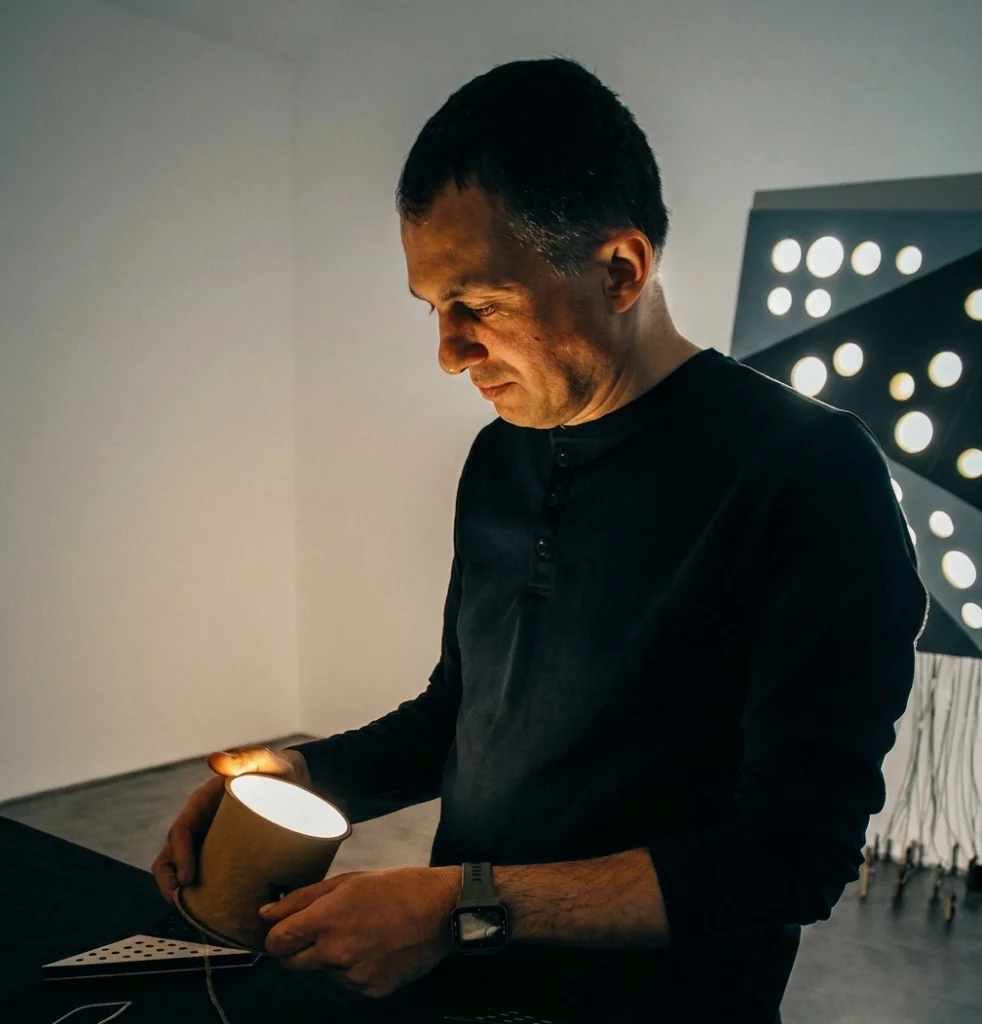
It is located within an arts cluster on the fourth floor, where bright, open studios of designers and artists line the corridor. Sasan’s space is different, situated at the very end behind a closed door. Stepping inside feels like passing through a portal into another environment. In dim lighting, kinetic sculptures hang, flicker, and vibrate, as if waiting to be activated. Some appear complete, others remain in a sketch-like state, as though capturing thought in motion. “This is far from everything, much more is in the garage,” the artist notes. Yet even what is visible is enough to understand that everything here is in motion, both works and ideas.
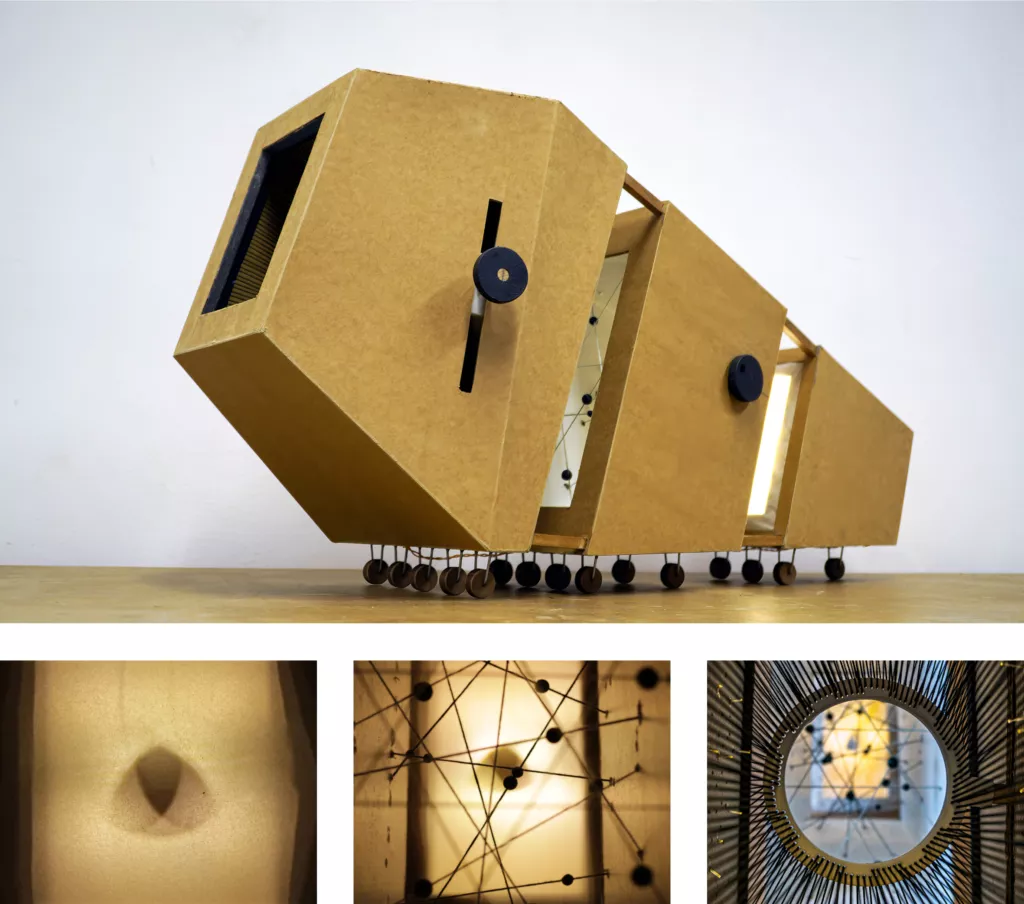
Sasan describes his practice as “abstract kinetic sculpture based on social mechanisms.” For him, movement is not only a physical phenomenon but also a form of communication and a way of thinking. Almost all works require participation: one must press a button, turn a lever, or touch a surface. Only then do they respond, producing sound, shifting form, emitting light, dispersing, or moving. The viewer is positioned not so much in front of a sculpture as within a process that gradually unfolds. The artist refers to his works as “portals” through which the viewer enters a space of reflection.
Originally trained as an architect-designer, Sasan describes his transition into art as a dramatic rupture, almost a dismantling of a previous logic. Design, he says, demands knowledge, precision, and purpose, whereas art allows for uncertainty and a sense of the unfinished. “You can say: I don’t know,” he notes, and this “not knowing” becomes a form of freedom. Thinking itself, he argues, must remain in motion: “if in two years I think the same way, it is no longer kinetic, but possibly aesthetic.”
Sasan was born in Tehran, Iran, grew up in Istanbul, Turkey, and has lived in London for over fifteen years. He describes this experience not in terms of a simple East–West relation, but as a difference in attitudes toward the style of thinking. Philosophy, in his view, is not about possessing truth, but about seeking it, a “love of wisdom.” Hence his reluctance to formulate definitive answers: his works do not assert but propose, they ask questions and remain open.
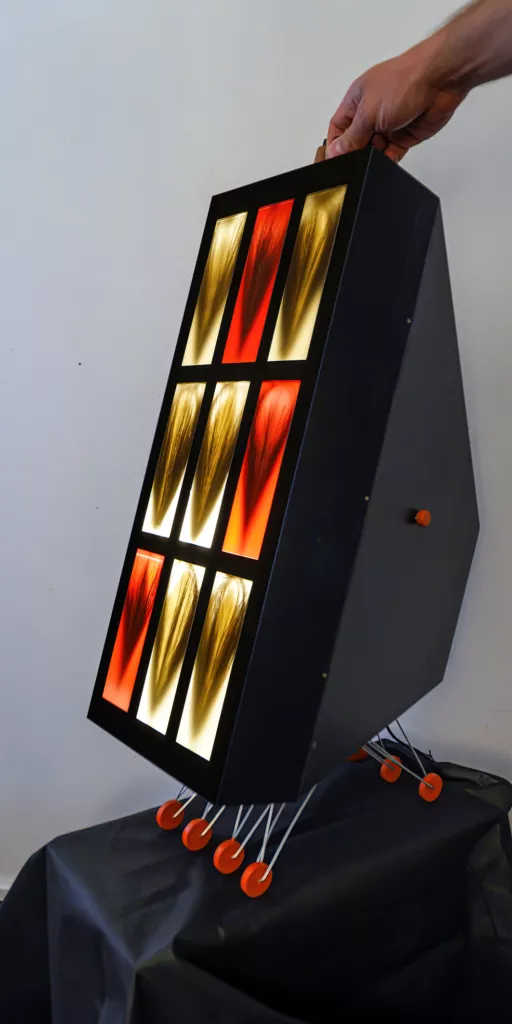
The sculpture Three Modules: Self-Retrospective (2022–23) can be read as a self-portrait. Its three components, I Was Born, I Was There, Here I Am!, trace the formation of the artist through time, geography, and state of being. Yet rather than fixing identity, the work destabilises it as elements activate, shift, and transform. Identity here emerges as a process and is never fully resolved.
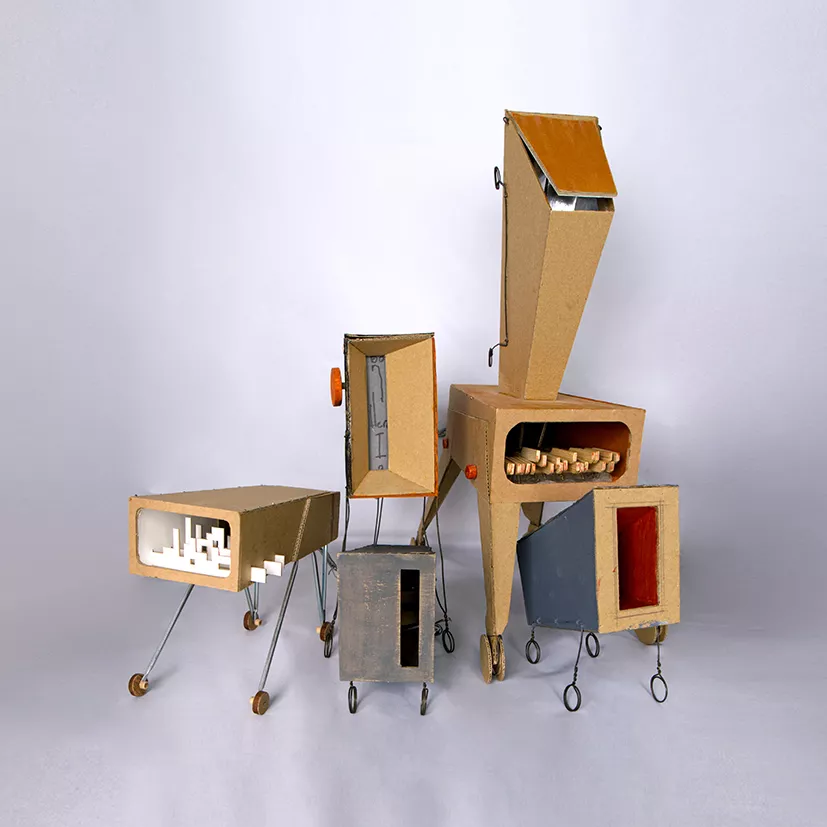
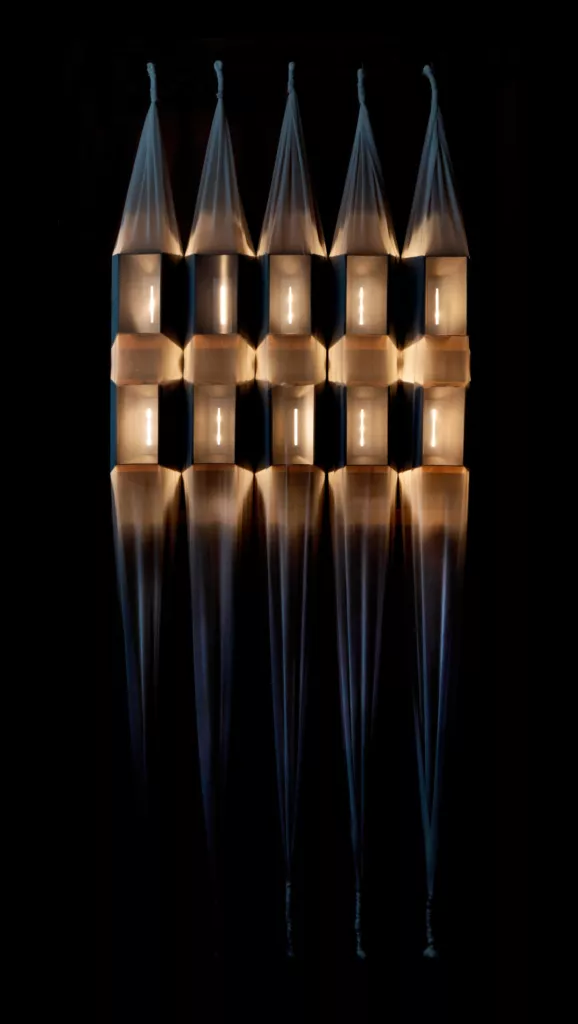
The theme of identity also unfolds in the Portals: Together series (2021). Small constructions made of cardboard, wire, and light must be held, activated, and set into motion. Only then do they begin to “speak,” opening a space for interpretation. One sculpture narrates a story of nostalgia: while living in the city, a person romanticises and longs for the forest they once inhabited (Forest to city, 2021). Other works appear as paired forms that connect into a whole, moving together, “befriending,” even “singing,” yet capable of separating and rolling away on their own wheels (The friends, 2021).
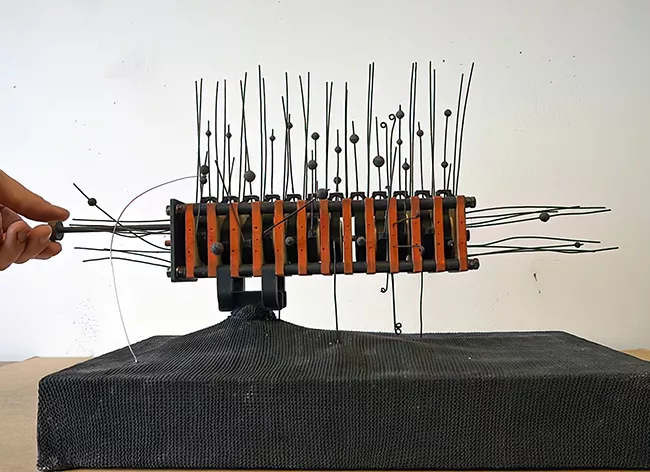
Over time, Sasan’s focus has shifted from identity toward broader social structures. “There has been too much obsession with identity,” he notes. His attention turns instead to the ways connections between people are formed and how they function. In Murmuration: A Social Mechanism (2023), he explores collective movement. Referencing the coordinated flight of birds without a leader, the work raises the question of whether such a model is possible within human societies. Elements placed on a platform collide, latch onto one another, and gradually form a shared rhythm.
This line of inquiry continues in the Death Rituals series (2023-24), where the artist considers how society constructs memory of the past. In Cemetery: Descry the honour (2023) and Wiggles: A conversation between the dead! (2024) and, the viewer is again drawn into interaction: touch activates sound, movement, and light. The focus shifts toward the living, those who assign meaning to the past and speak on behalf of those who can no longer respond.
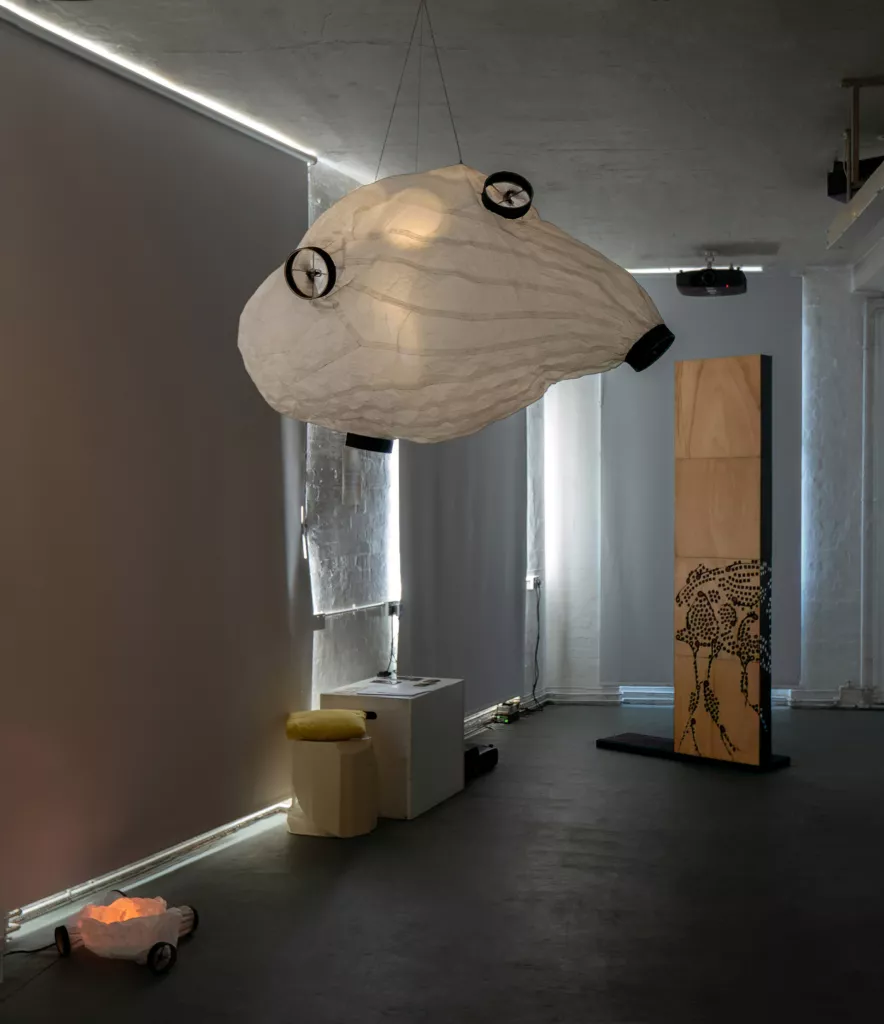
In the Powerscape series (2025), Sasan approaches power not as a fixed hierarchy but as a dynamic relation. In one work, an “animal” appears, a suspended form that breathes and pulses, suggesting an inner force resistant to full control (An Animal Within Us). In The Monolith, touch triggers light and sound, prompting an almost ritualistic response. In another model, resembling a pyramid of black-and-white spheres, movement disrupts the apex while the base remains stable, challenging assumptions about where power resides.
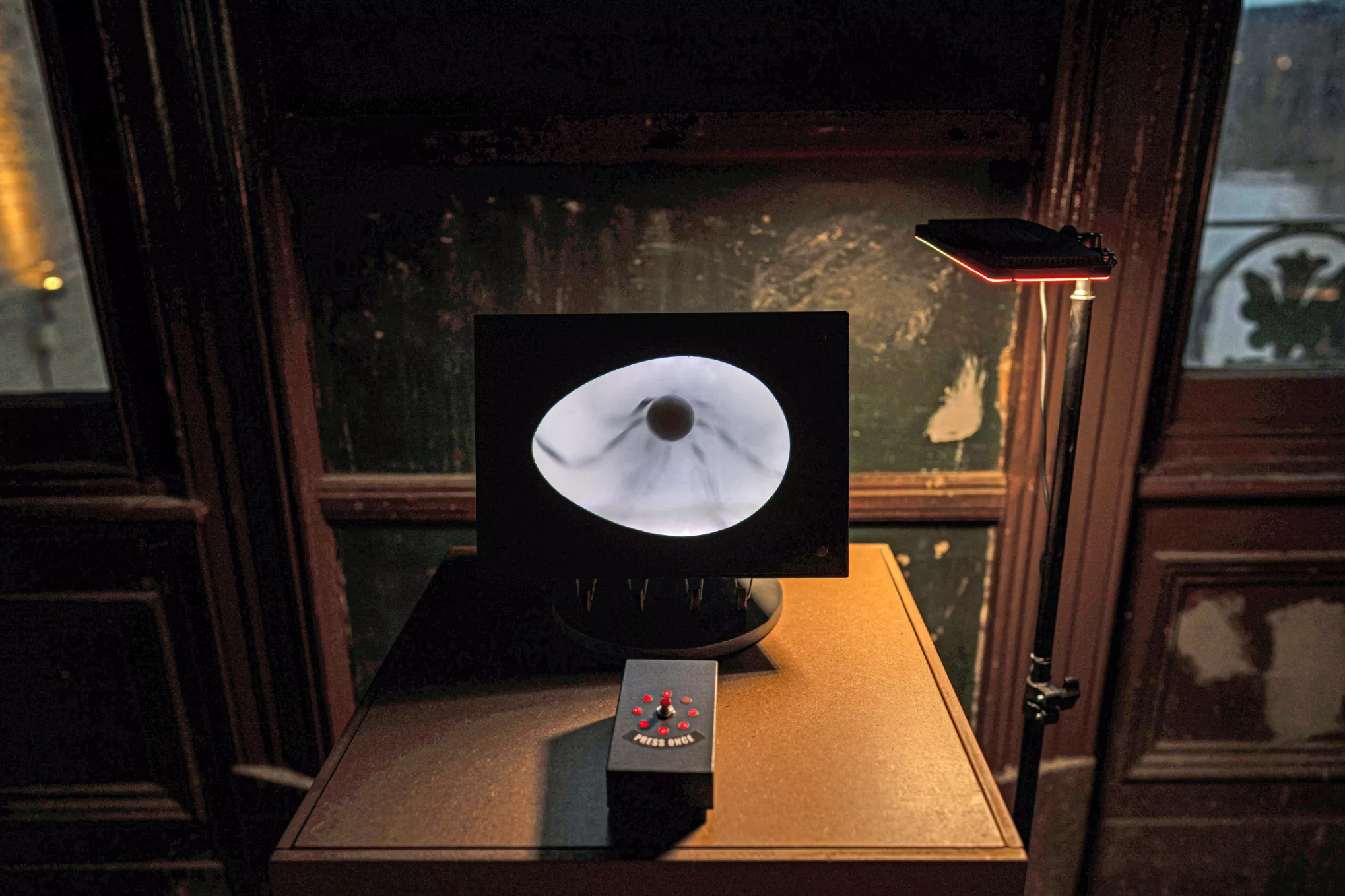
From here emerges the question of freedom. Following Isaiah Berlin’s distinction between “freedom from” and “freedom to,” Sasan explores the relationship between external and internal freedom. Liberation and freedom are two different notions. In Portals: Tension (2021), he addresses how individuals become enclosed within systems where constraint is externally imposed. On screen, a black dot moves within a confined space, never crossing its boundaries and drawn to the centre by society. These forms evoke persistent associations, an eye, a womb, or a chicken egg. “Why do we immediately think of a chicken egg?” Sasan asks. Most eggs in nature are not chicken eggs and have different shapes, yet we see what we are accustomed to. In this automatism, he identifies a misunderstanding of the notion of freedom, a dependence on inherited images and patterns of thought.
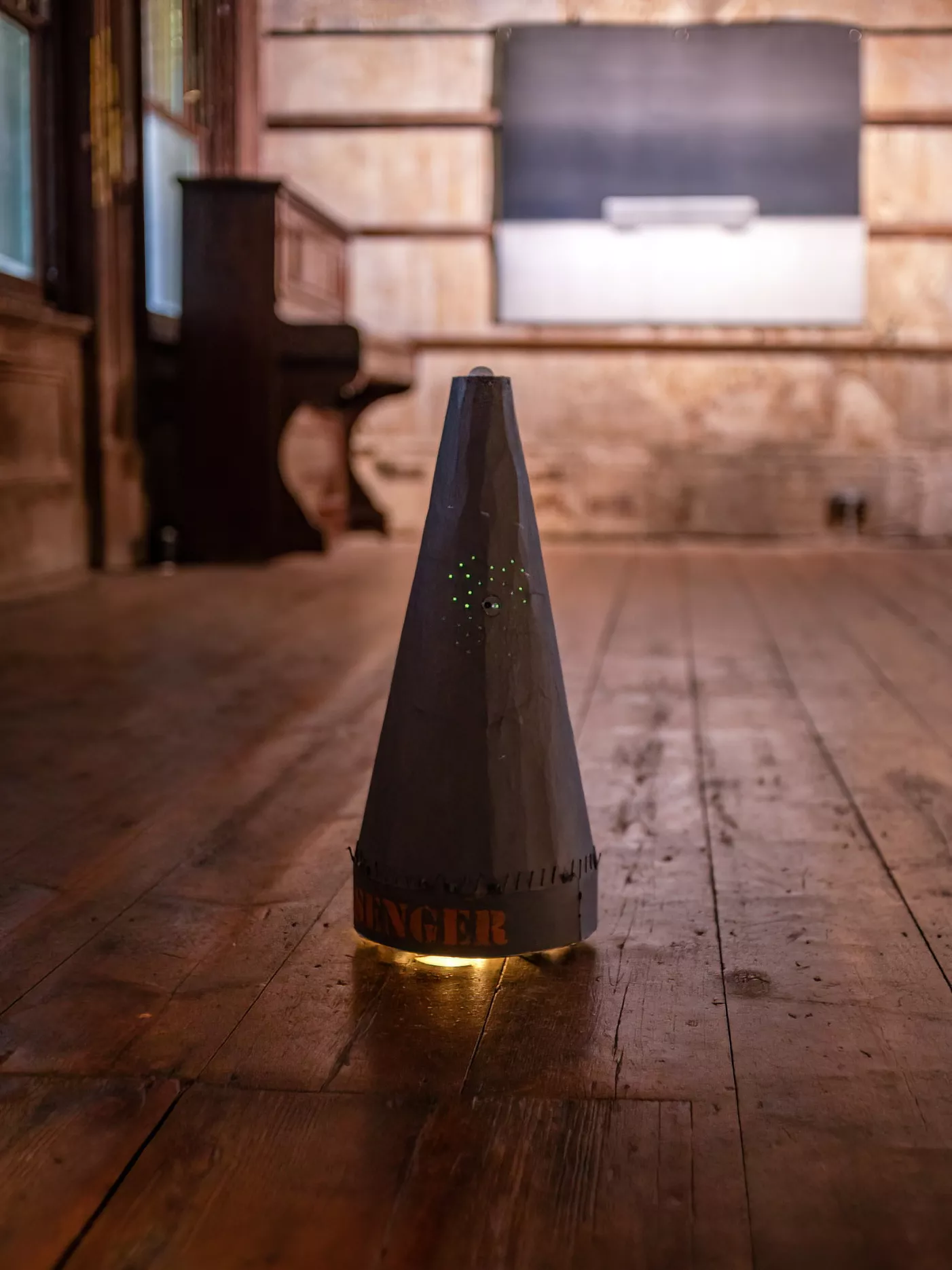
This idea develops further in The Last Passenger (2025). If in Tension constraint is external, here it becomes internal. A cone shaped artwork moves across the floor without a fixed direction, emitting light signals reminiscent of Morse code, yet remaining unread. The signal finds no response. “He is trapped in his own head,” Sasan explains. Even in an open space, movement remains limited, though not chained by society The Last Passenger is not free. Liberation is not enough for freedom.
The artist notes that he himself is engaged in an ongoing search to find the meaning of freedom, and that working with kinetic sculptures is, for him, a way of freeing himself from imposed assumptions and constraints. Sasan Sahafi’s practice resists a single definition, existing between the making of kinetic sculptures, research, and philosophy. His works invite dialogue, offering viewers a way to see the familiar anew.