 Loading...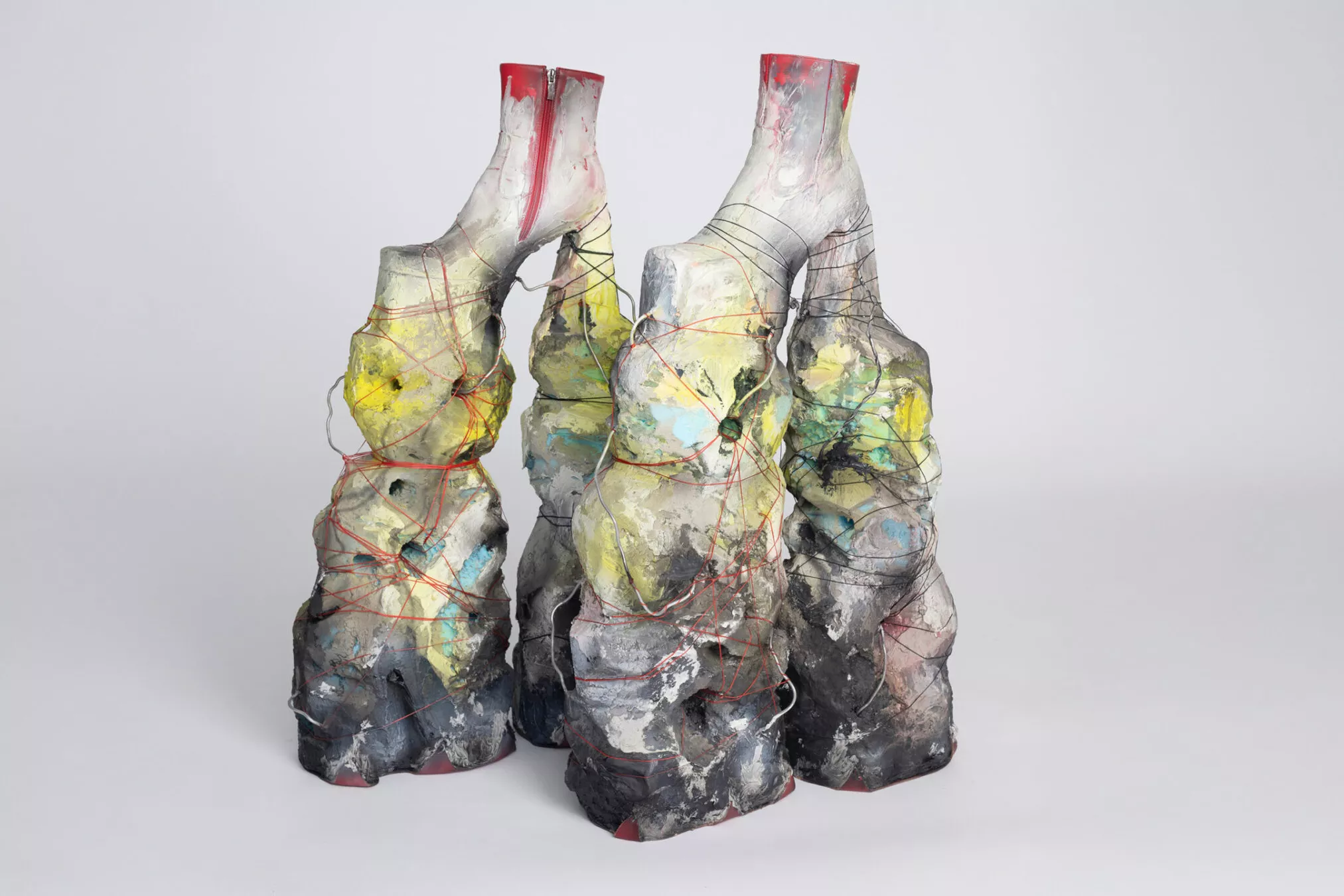
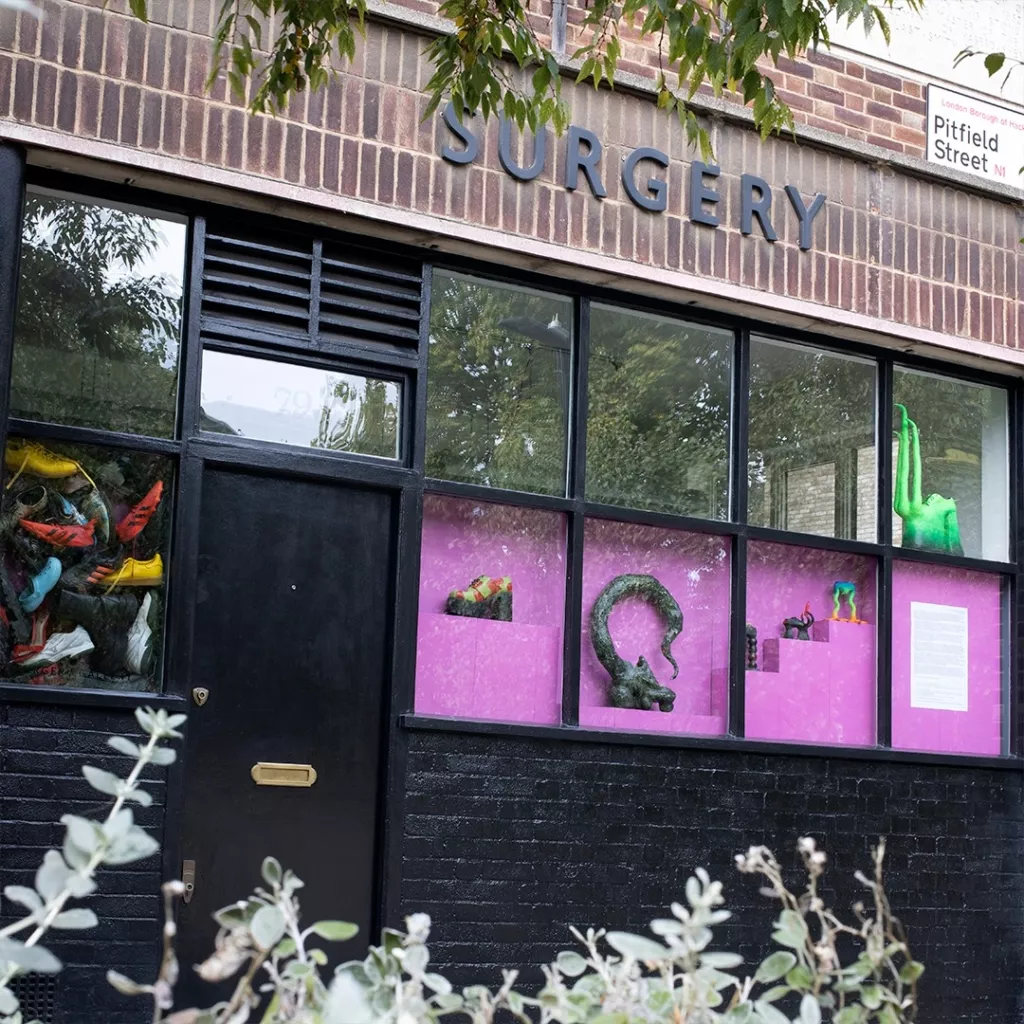
At first, the geometry of the windows seems a narrow constraint, yet it proves sufficient to establish an autonomous environment. In this environment the exhibits achieve an overall balance, although they never quite align individually, as if each held its own position on the uneven treads of a staircase. Turned along different axes, each pointing its own way, they all, according to the curatorial explication, represent transition — much as the step itself (the source of the project’s inspiration), can symbolise anything from a single thought to a whole social process.
The imperative here is not simply forward motion. Bosani’s work goes in unexpected directions: through the history of shoemaking he explores how movements (whether a gait or a turn in fashion) are shaped and how craft knowledge might be mobilised to reimagine their choreographies. He works mainly by experimenting, with size and material, so that queer forms he produces (used in his performances but hardly wearable elsewhere), challenge the utilitarian codes of what an object, or a body, is permitted to be.
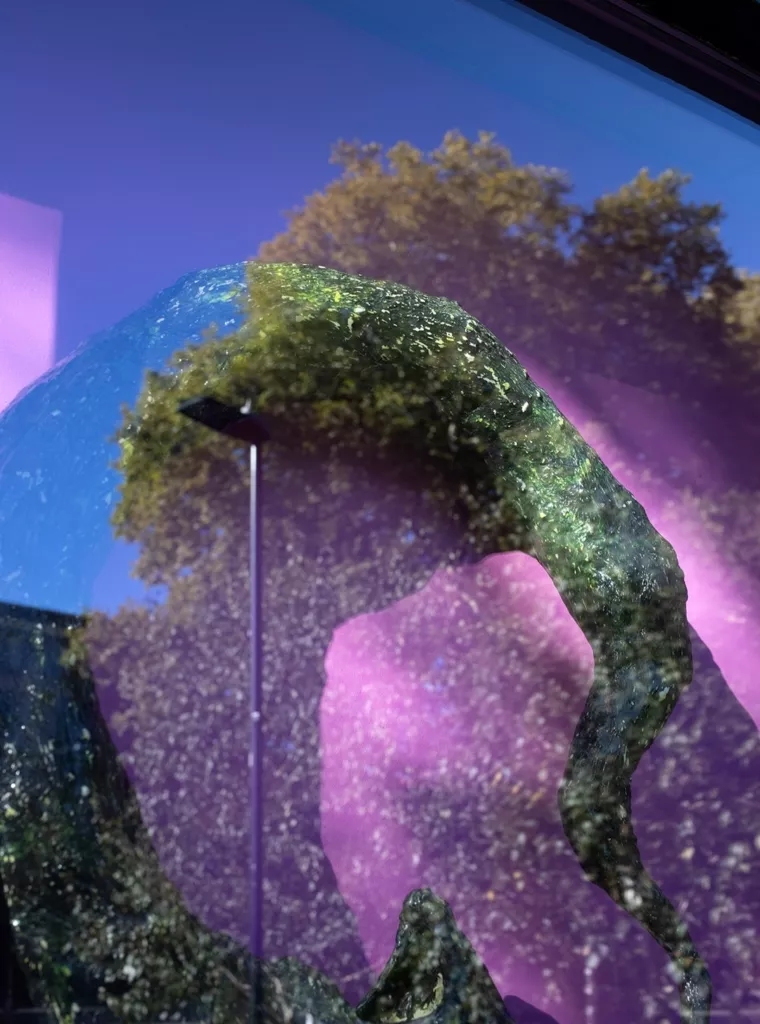
Every object, however, begins as a problem of fit. In the first vitrine, Gurn has Bosani pack every conceivable kind of footwear into a single compressed mass — boots, heels, slippers, the extravagant and the ordinary. This space is then sealed, producing a collision between the volume of the shoes and the constraint of the vitrine. No detail in Steps is allowed a single function, which is kind of a curatorial surgery itself. The partitions,painted in a vivid fuchsia, do double duty: as structure and as contrast; the proportions of the niches both contain the objects and frame them. The experimental staging may also be read as a form of resistance to institutional inertia, in the lineage of Hans Ulrich Obrist’s early “kitchen” exhibitions (World Soup, 1991) or Duchamp’s Boîte-en-valise. In all these projects the reduction of size is chosen in advance, not as an imposed constraint but as a statement that art requires no capital of square meters in order to take place.
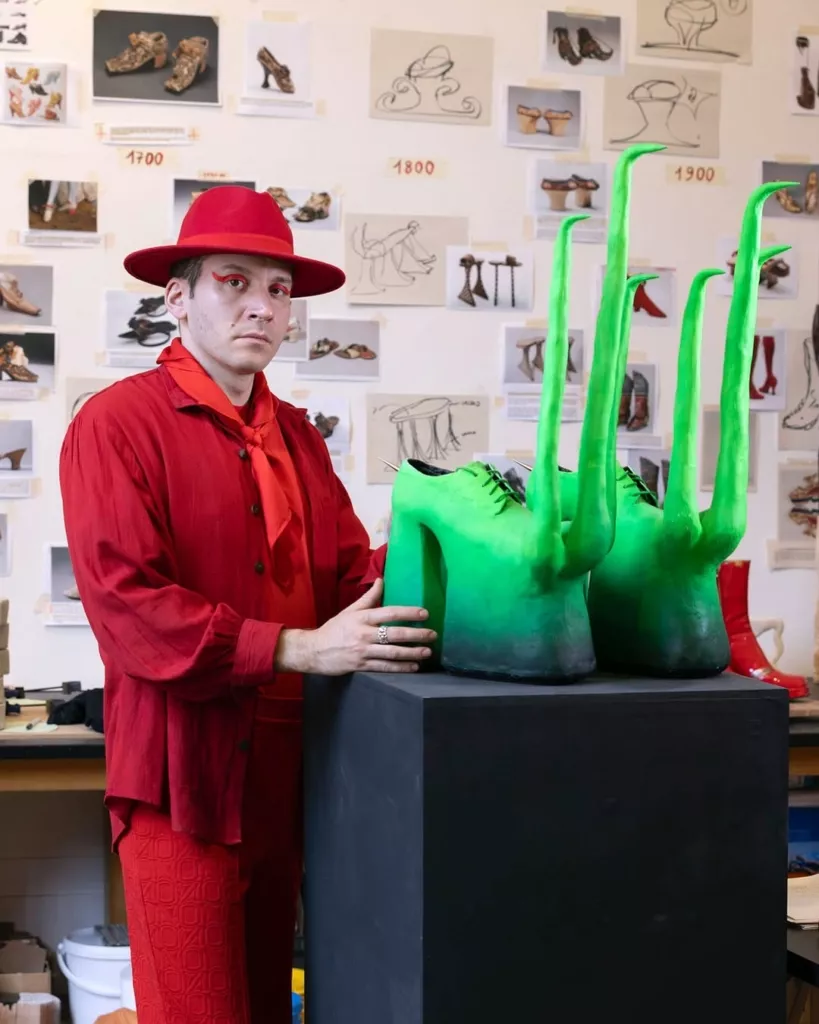
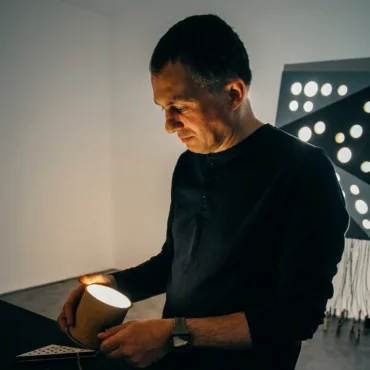
Luca Bosan with his artwork. Courtesy of the artist
For all that, the greater part of the perceptive labor in Steps falls on the viewer, who is invited to reorient their sense of scale away from the spatial (at least from the street’s own measure) and toward the intensive. An experiment of this sort, evidently, is not addressed to the crowds cycling past the gallery, pausing only rarely to look closer. No one can simply choose, midstreet, to switch into another mode of perception — contemplative rather than linear.
The final exhibit, that giant green shoe, demonstratively exceeds the boundary of its allotted rectangle. Unlike the other objects, it fits neither body nor frame: a stray thought, off-pattern from regular thinking, waiting there before anyone arrives.
Out of Steps, Bosani and Gurn construct something closer to a shelter than a display case, a shelter where the works are shielded equally from general understanding, from street and from institutional scale. At the same time, the format restores to the relationship with the viewer an intimacy lost in vast spaces, and with it, Steps holds itsground as a concentrated act of effort.
When the city sinks into darkness (and in London, come autumn, this happens early enough), the windows of Surgery Gallery switch on. With this corner of the street left otherwise unlit, the strip of fuchsia glow itself starts to resemble a “step” laid into space. To “make out the steps,” the viewer paradoxically stands motionless, targeting this or that object with the gaze, only occasionally shifting sideways — step by step — only to find that everything has already been seen. Or already walked through.
The exhibition is open at Surgery Gallery, 79A Pitfield Street, London, N1 6BT, UK, from 18 October to 14 November.